
This 67YO female woke with bilateral blurred vision and severe eye pain. She was started on Lexapro (escitalopram) six months earlier. Vision was 20/400 OD and 20/100 OS.
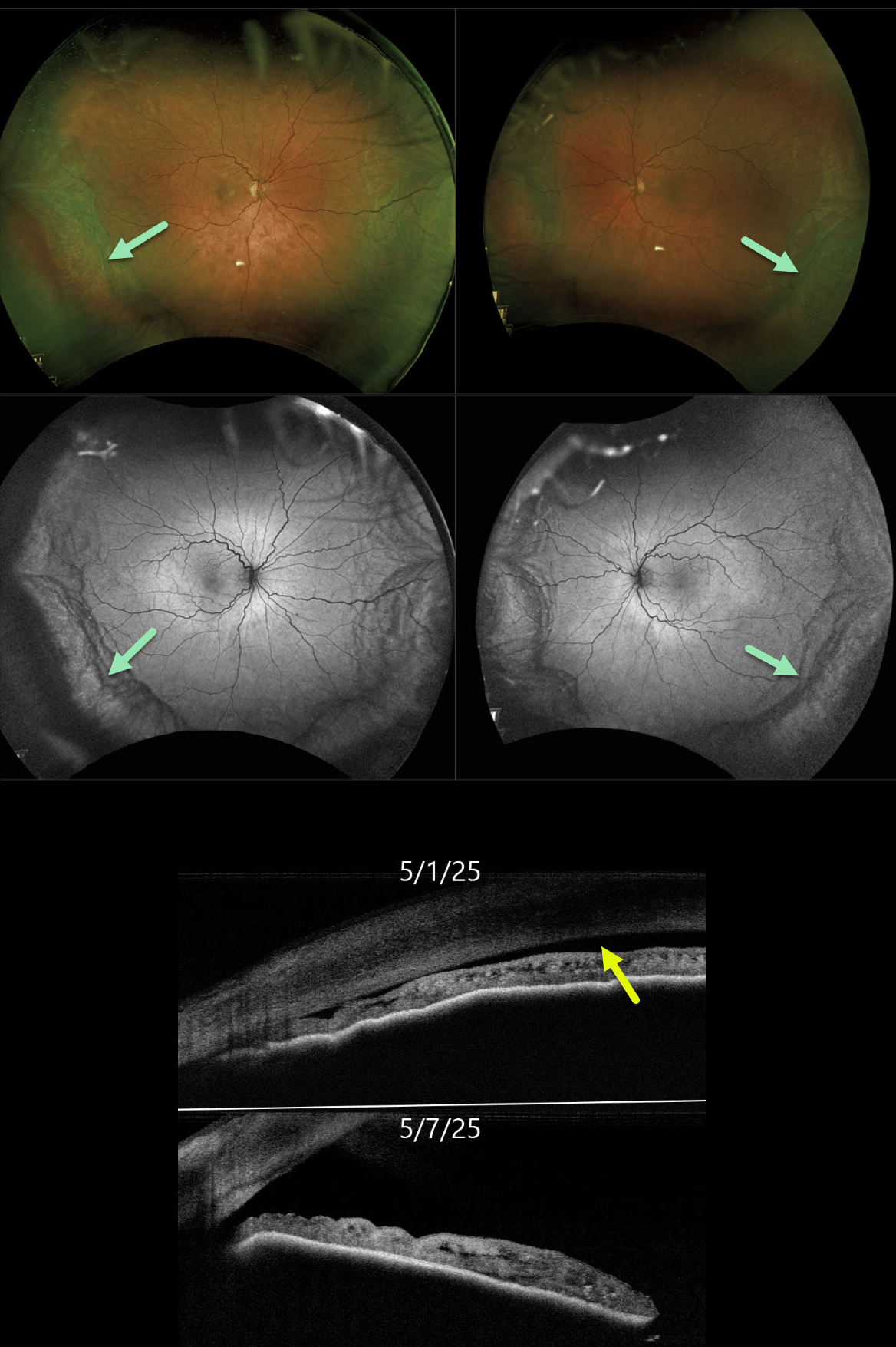
Slit lamp examinations showed bilateral shallow anterior chambers, with no angle structures visible in either eye on gonioscopy and anterior segment OCT. Intraocular pressures (IOP) were 50 mmHg OD and 44 mmHg OS.
Optos color RG and green channel imaging shows bilateral peripheral encircling choroidal detachments. Anterior segment OCT confirmed a flat anterior chamber. Rocklatan, Simbrinza, Alphagan, Atropine, and Diamox were administered in the office, with the IOP decreasing to 38 OD and 36 OS. We contacted her primary care doctor to discontinue the Lexapro. One week later, vision improved to 20/30 OD and 20/25 OS. IOP was 16 OD and 13 OS, the anterior chamber angles were open clinically and on OCT, and the choroidal detachments were decreasing.
Learning Points:
Drug-induced ciliochoroidal effusions with secondary angle closure glaucoma (ACG) are a known complication of topiramate therapy, but have also rarely been reported with selective serotonin reuptake inhibitors, including escitalopram (Zelefsky et al, AJO 2006;141:1144-1147). Unlike typical ACG, which is cured with a peripheral iridotomy, these drug-induced ACG attacks are treated with dilation. Atropine paralyzes the ciliary body, which allows the lens/Iris diaphragm to return to its natural state, rotating backward and increasing the anterior chamber depth. Topical steroids help decrease uveal vascular permeability, thereby reducing choroidal effusion.