
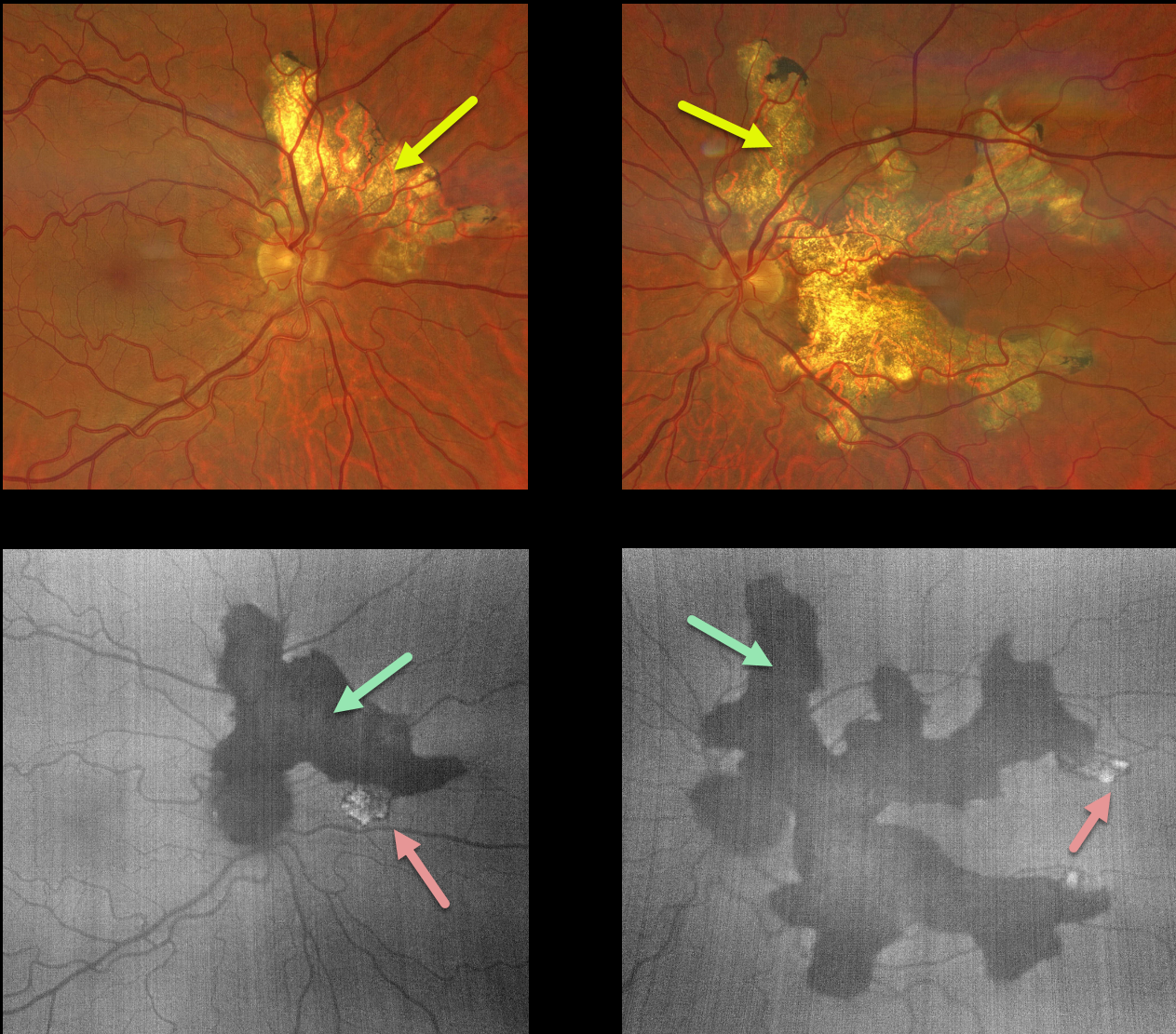
This healthy 54YO male presented for a second opinion for untreated serpiginous chorioretinitis that was diagnosed 2 years earlier. Vision was 20/20 OD and 20/200 OS.
Color imaging shows bilateral chorioretinal scarring that extends outwards from the optic nerves. This scarring is more extensive OS and spares the macular center. On fundus autofluorescence (FAF), this scarring is diffusely hypo-FAF except for a few margins bilaterally that are hyper-FAF.
Learning Points:
Serpiginous choroiditis is an idiopathic, usually bilateral chorioretinal inflammatory condition most commonly found in middle-aged men (Khanamiri and Rao, Surv Ophthalmology 2013;58:203-232). Recurrent areas of inflammation develop along the edge of a previous scar, producing scarring that meanders from the optic nerve outward into the macula.
Vision is good unless scarring or macular neovascularization extends through the macular center. There is no consensus on the optimal systemic treatment, including corticosteroids and systemic steroid-sparing agents.
Tubercular serpiginous-like choroiditis mimics serpiginous, but affects younger patients with more multifocal and peripheral recurrences and progression if untreated (Agarwal et al, AJO 2020;220:160-169).
We felt the hyper-FAF lesions in our patient possibly indicated active disease, so prednisone 40mg PO for 10 days was prescribed. Tuberculosis workup was negative.