

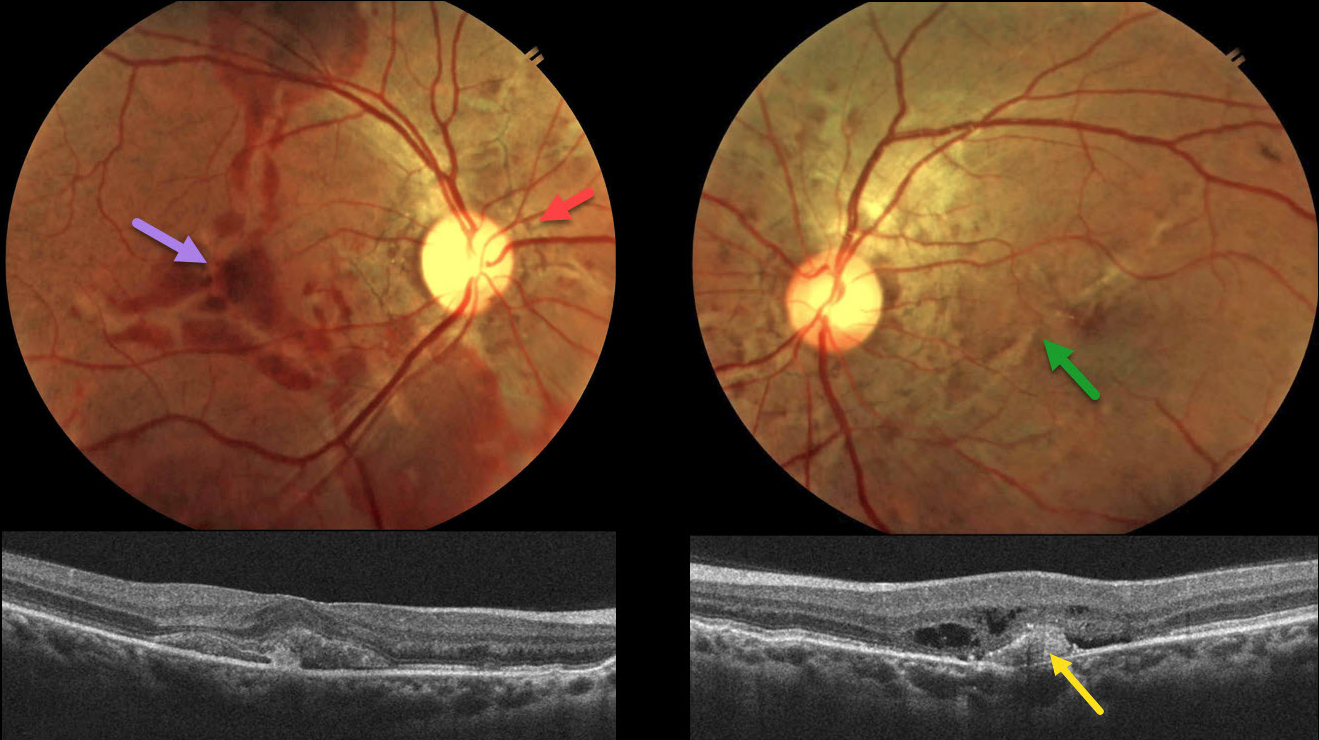
This 38YO male presented with 10 days of bilateral vision loss after being hit in the right eye with a fist. He denied any past medical history, and family history was negative for eye disease. Vision was 20/200 OD and 20/80 OS.
Color fundus photography shows irregular orange-gray lines radiating outwards from each nerve. Variable areas of subretinal blood are noted in the right macula, extending into the superior and inferior midperipheries. There is milder subretinal blood OS along with an irregular oblique macular angioid streak vs choroidal rupture. OCT OD shows subretinal hyperreflective material, likely blood. A possible type 1 (below the RPE) MNV with some outer retinal fluid is seen OS.
An anti-VEGF injection was given bilaterally, but unfortunately, the patient was immediately lost to follow-up.
Learning Points:
Initially described by Doyne in 1889, angioid streaks are orange-yellow, irregular, crack-like dehiscences in Bruch’s membrane associated with atrophic degeneration of the overlying RPE. The term “angioid” derives from its resemblance to blood vessels. Although they are historically mistakenly associated with numerous conditions, the only real association is with pseudoxanthoma elasticum (PXE, Nadelmann et al, Eye 2023;37:1596-1601). Patients are at significant risk for vision loss from MNV or pattern dystrophy-like changes (Murro et al, Graefe’s 2020;258:1881-1892).
Even minor trauma can cause choroidal ruptures with subretinal blood (Agrawal et al, JAMA Ophthalmology 2017;135(3):e165466). Unlike typical choroidal ruptures that are usually curvilinear with the nerve, the lesions from the brittle Bruch’s membrane in PXE appear as numerous irregular ruptures usually radiating from the nerve. Even though our patient sustained a direct injury to his right globe, the trauma was significant enough to cause choroidal ruptures in his left eye. The bilateral subretinal hemorrhages may be purely avascular, as their multifocality suggests.