
This 18YO male, originally from the Dominican Republic, was first seen by an ophthalmologist at 14YO due to strabismus. At that time, he was found to have a significant morning glory anomaly.
Two years later, at age 16, he developed a right-sided facial palsy and, on work-up, was found to have a right optic nerve sheath meningioma. He was then genetically confirmed to have neurofibromatosis 2 (NF-2).
There was an unclear treatment history, and he recently presented to our clinic to establish care. Vision was no light perception in his right eye and 20/25 in his normal left eye.
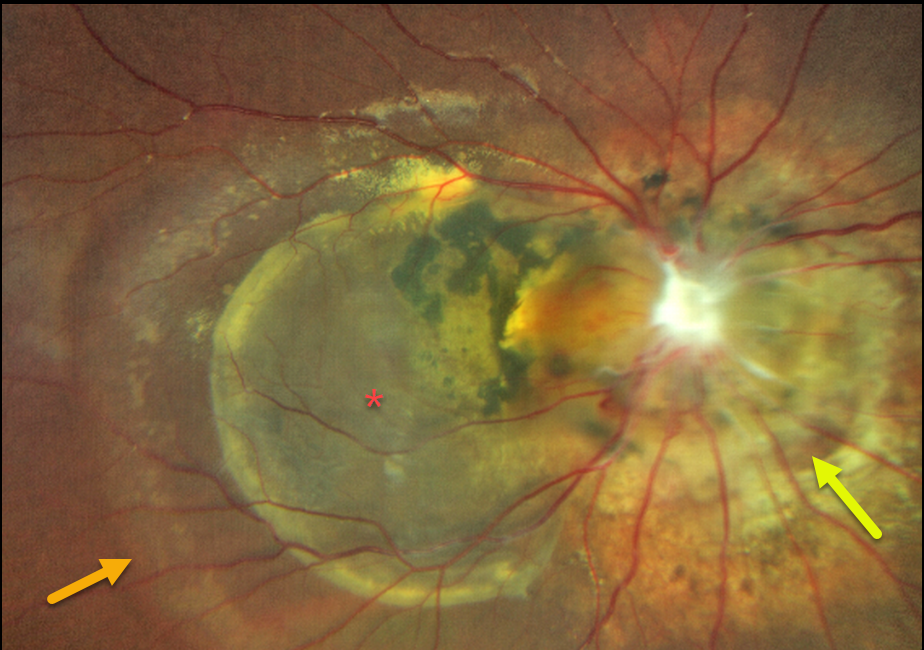
Optos color RG imaging shows a morning glory disc with peripapillary chorioretinal scarring, an associated chronic retinal detachment, and a large macular cyst.
Learning Points:
Neurofibromatosis type 2 (NF2) can arise spontaneously or be inherited as an autosomal dominant mutation in the NF2 gene located at chromosome 22q12.2.
The hallmark sign of NF2 is bilateral vestibular schwannomas (or acoustic neuromas). Other manifestations of NF2 include cranial meningioma, spinal ependymomas, and peripheral nerve tumors. The most common ocular finding is a posterior subcapsular cataract in young patients.
Less common findings include optic nerve meningiomas, papilledema, strabismus, epiretinal membrane, and combined hamartoma of the retina and RPE.