
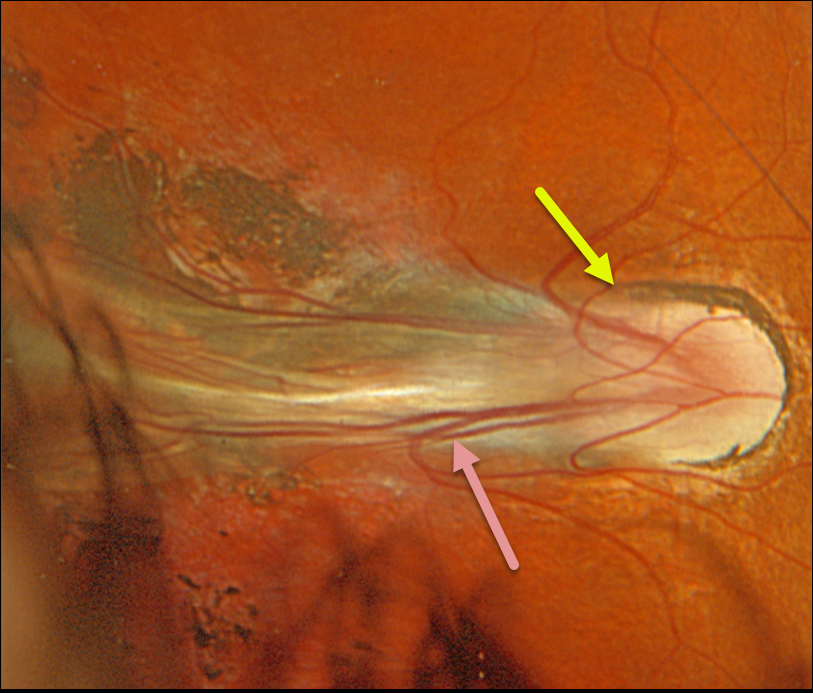
This 22YO female presented with a lifelong history of stable severe bilateral vision loss, congenital nystagmus, and a prior inoperable retinal detachment in her left eye. There was no past medical or family history of eye disease.
Optos color RGB imaging of her right eye shows temporal dragging of the disc and vessels from a falciform retinal fold extending towards the periphery. Secondary surrounding pigmented chorioretinal scarring is noted.
The left eye had a dense white cataract with no view of the posterior pole. Genetic testing was positive for a pathogenic KIF11 mutation.
Learning Points:
Originally described by Criswick and Schepens (AJO 1969;58;578-594), familial exudative vitreoretinopathy (FEVR) can be inherited as an autosomal-dominant, recessive, or X-linked trait with high penetrance and variable expressivity.
FEVR is characterized by peripheral temporal retinal avascularity, lipid exudation, neovascularization, tractional retinal detachment, and temporal dragging of the macula and retinal vessels. These findings are somewhat similar to those found with retinopathy of prematurity (ROP).
There are numerous genes associated with FEVR, including LRP5, FZD4, NDP, TSPAN12, ZNF408, CTNNB1 and KIF11 [Tao et al, Invest Ophthalmol Vis Sci 2021;62(15);4].
The exact mechanism by which KIF11 mutations cause FEVR is not fully understood. However, it is thought that mutations in the KIF11 gene disrupt the transport of vesicles and organelles essential for retinal blood vessel development.