
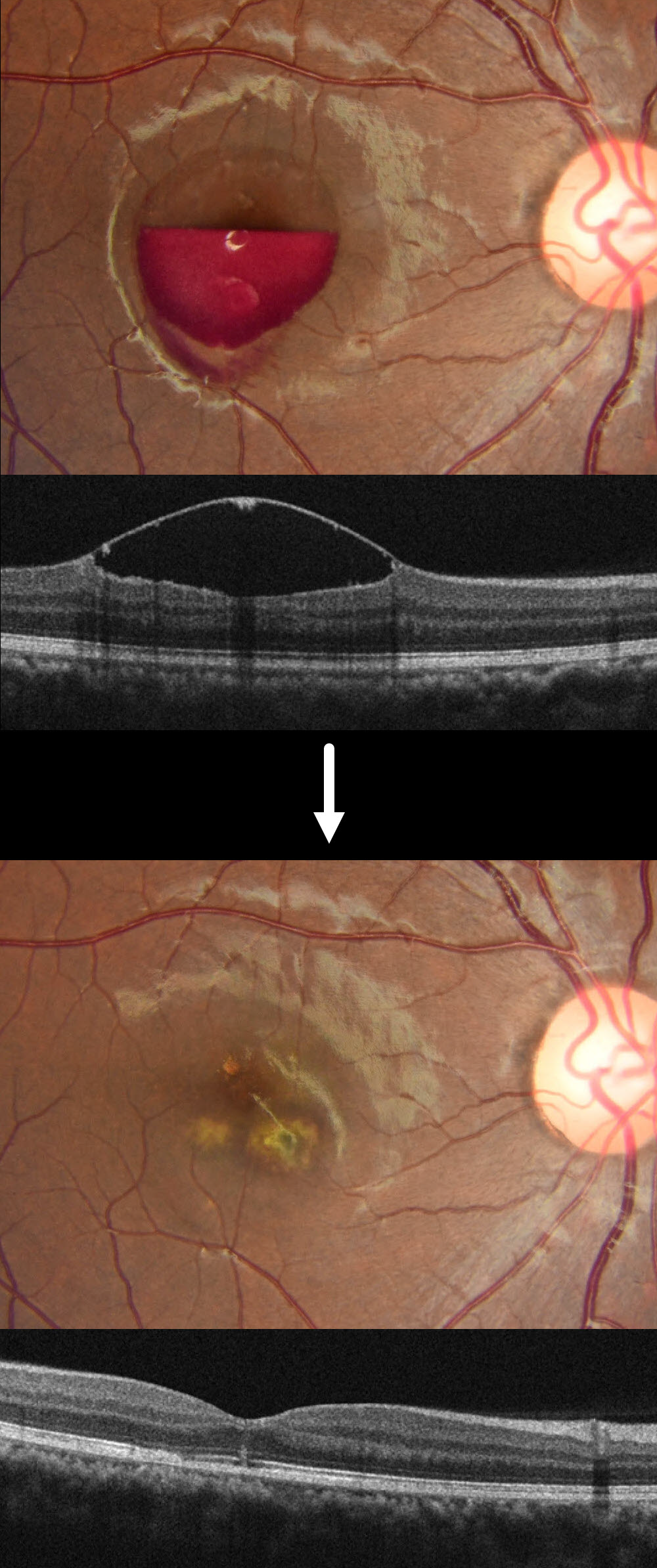
This healthy 19YO female noted sudden vision loss in her right eye immediately after looking directly at the light while attending a DJ laser party. When she presented to us 2 days later, her vision was hand motion OD and 20/20 in her normal OS.
Fundus photography and OCT show a partially layered central macular sub-internal limiting membrane (ILM) hemorrhage.
When examined 1 week later, the blood was drained via a YAG laser due to no improvement in her vision or sub-ILM blood. Two months later, vision improved to 20/20 despite multiple paracentral scars.
Learning Points:
DJ laser machines typically fall into Class 3R or Class 4, depending on their power output. These lasers emit visible light in the red (635-650 nm), green (520-532 nm), and blue (445-460 nm) wavelengths, often combined for full RGB effects. While visually stunning, high-powered lasers, especially Class 4, can pose serious risks, including retinal burns, if beams enter the audience area or are viewed directly. Blue wavelengths are particularly hazardous due to their shorter wavelength and higher energy density. A strikingly similar case to our patient was reported by Perz-Montano et al (Doc Ophthalmol 2019;138:71-76).
To protect audiences, professional setups use a combination of engineering controls and regulatory compliance. This includes fail-safe scanning systems, beam termination zones, and power-limiting protocols to remain below the Maximum Permissible Exposure. In the US, the FDA’s Center for Devices and Radiological Health oversees these devices, requiring manufacturers to submit safety documentation and operators to file a Laser Light Show Variance for public performances. Proper mounting, trained personnel, and adherence to ANSI and IEC standards are essential to ensure safe and compliant laser shows.