

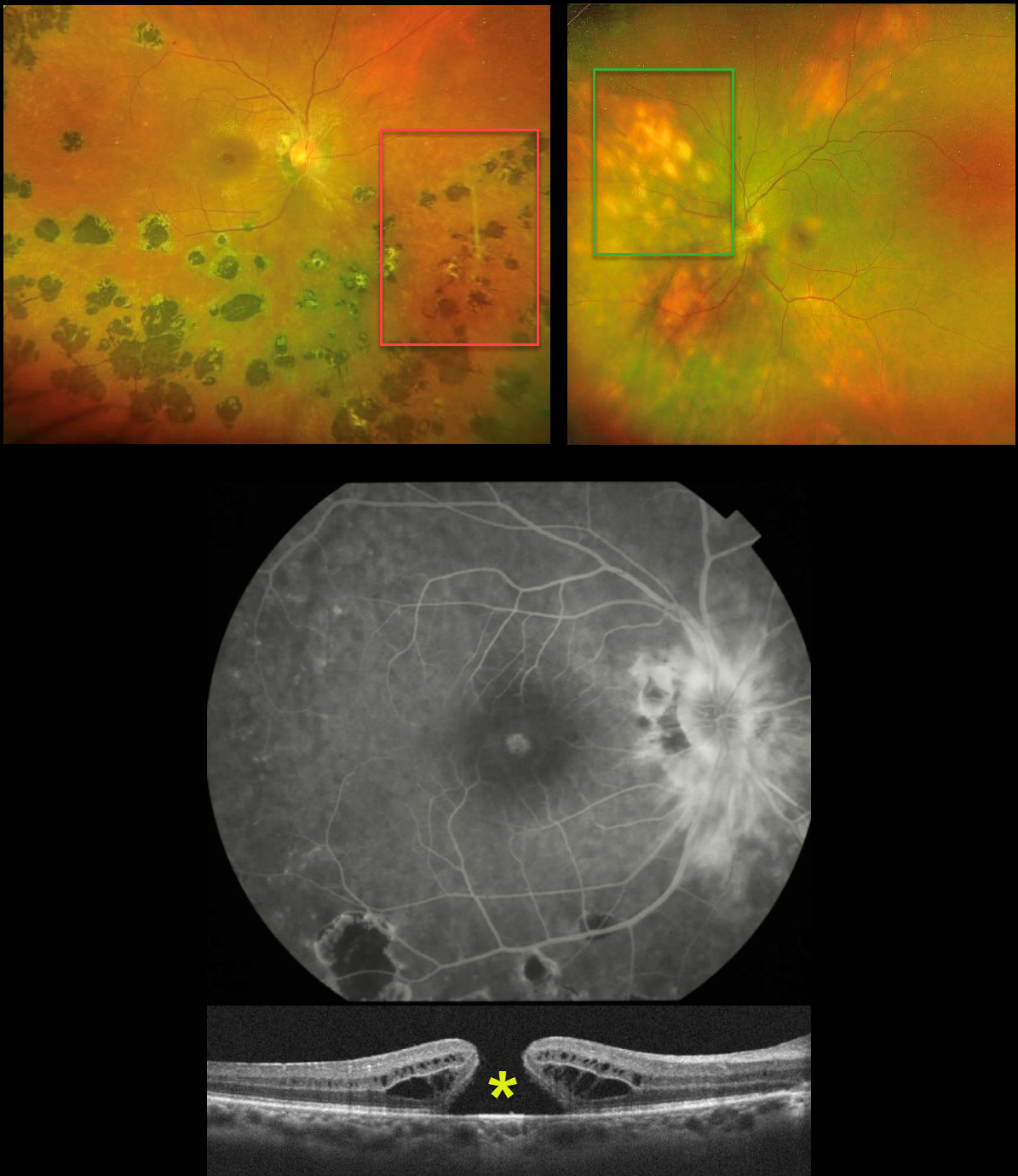
This healthy 41YO female presented with 6 months of bilateral vision loss. Vision was 20/240 OD and 20/200 OS.
Optos color RG imaging OD shows peripapillary scarring, multifocal large hyperpigmented chorioretinal scars scattered inferiorly and temporally, and some vascular sheathing. A full-thickness macular hole is noted and confirmed on OCT. Fluorescein angiography shows peripapillary leakage.
Her left eye’s Optos shows markedly different findings, with multifocal, creamy-white, depigmented lesions in a pattern radiating away from the disc.
Medical workup was negative, including HLA-A29, QuantiFERON TB Gold, chest X-ray, and serologies for toxoplasmosis and CMV.
Learning Points:
Birdshot chorioretinopathy was appropriately described and named by Drs. Ryan and Maumenee (Am J Ophthlamol 1980;89:31-45) since the lesions look like shotgun birdshot scattered throughout the fundus. Birdshot is typically chronic and bilateral, with about 90-95% of patients being HLA-A29 positive and usually affects women in their 40s to 60s.
Multifocal choroiditis (MFC) is the current preferred term for a group of historically heterogeneous disorders, including multifocal choroiditis, recurrent multifocal choroiditis, multifocal choroiditis and panuveitis, punctate inner choroidopathy, progressive subretinal fibrosis, and pseudo-histoplasmosis (Essex et al, Retina 2013;33:1-4 and Spaide et al, Retina 2013;33:1315-1324). MFC occurs in otherwise healthy adults, often myopic and female. Findings include variably pigmented multifocal scars throughout the fundus, panuveitis, subretinal fibrosis, and macular neovascularization (MNV).
Our patient’s diagnosis is unclear because her right eye shows features suggestive of MFC, while her left eye is fairly pathognomonic for birdshot. In our experience, birdshot lesions never become hyperpigmented, as in our patient’s right eye, although the lesions in her left eye are virtually pathognomic for birdshot.
Following several Remicade treatments, vision remained stable at 20/240 OD and improved to 20/50 OS. We continue to follow her closely.
What’s your diagnosis???