
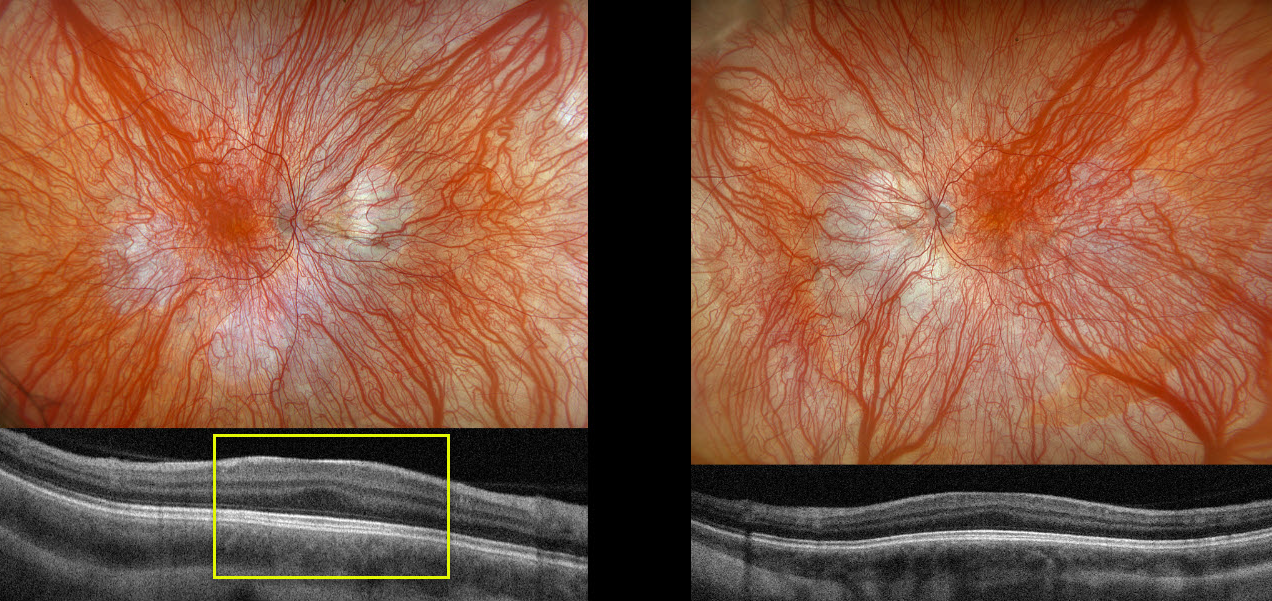
This 9YO girl was referred by her local ophthalmologist for esotropia, nystagmus, light hair, and skin, first noticed when she was 3 years old. She has a known history of Hermansky-Pudlak syndrome (HPS), diagnosed with genetic testing 3 years earlier. There is no history of parental consanguinity or of familial inherited retinal diseases. Vision was 20/63 OD and 20/80 OS. There were bilateral iris transillumination defects.
Optos color RGB imaging shows bilateral marked choroidal hypopigmentation with foveal hypoplasia. OCT scanning shows a flattened foveal contour bilaterally (fovea plana).
Learning Points:
Albinism is a group of genetic disorders characterized by abnormal melanin production due to faulty amino acid production. Patients have either ocular (eye) albinism or oculocutaneous (eye and skin) involvement. Inheritance patterns include autosomal dominant, autosomal recessive, and X-linked. Ocular findings include strabismus, nystagmus, iris transillumination defects, blonde fundus, and foveal hypoplasia (seen on OCT as fovea plana). There are often a higher number of crossed nerve fibers at the optic chiasm.
HPS is a rare autosomal recessive multisystem disorder characterized by oculocutaneous albinism, bleeding diathesis due to platelet storage pool deficiency, progressive pulmonary fibrosis, and granulomatous colitis. The underlying pathogenesis involves mutations in at least 10 genes encoding components of protein complexes (BLOC-1, BLOC-2, BLOC-3, and AP-3) essential for the biogenesis and trafficking of lysosome-related organelles in melanocytes, platelets, and other cell types. Our patient had a pathogenic c.223C>T p.(Gln75) homozygous variant in the HPS6 gene, which encodes for a key protein in the BLOC-2 pathway.