

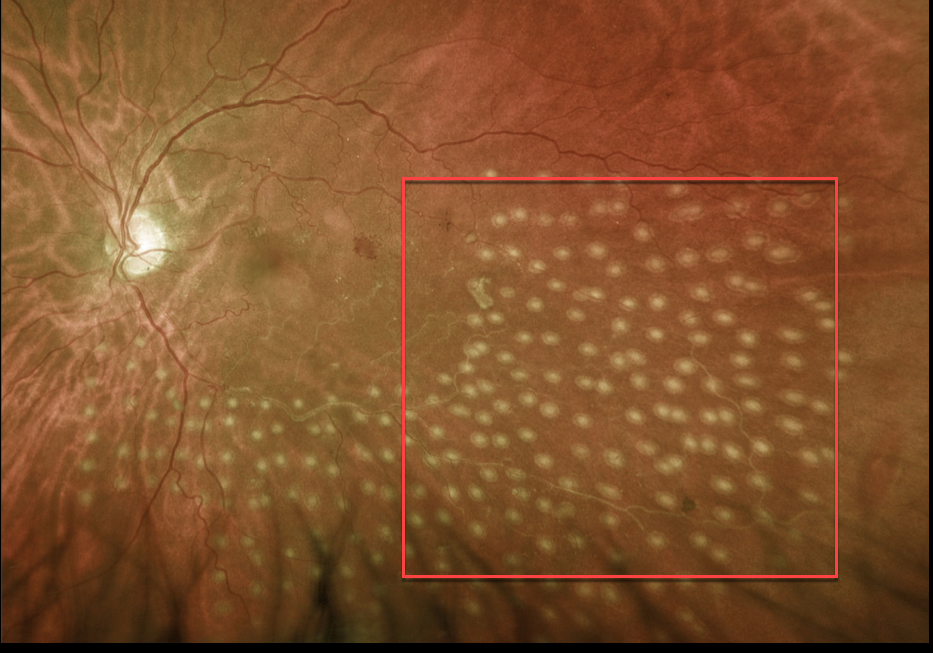
This 64YO female presented with one month of symptomatic vitreous floaters and 20/70 vision in her left eye.
Clinical examination and Optos photography with fluorescein angiography (not shown) confirmed an inferotemporal ischemic branch retinal vein occlusion (BRVO) with severe ischemia and scattered areas of retinal neovascularization.
She was scheduled to return for scatter laser photocoagulation, but was lost to follow-up. She presented 6 months later with one day of severe vision loss OS, now at 20/200. A significant vitreous hemorrhage precluded laser, so two monthly intravitreal Avastin injections were given.
Following this, the hemorrhage decreased enough to allow for scatter laser into the involved quadrant.
Learning Points:
In 1986, the Branch Vein Occlusion Study Group reported that scatter laser decreased the risk of vitreous hemorrhage from retinal neovascularization in BRVO, and suggested that laser should be applied once neovascularization develops (Arch Ophthalmol 1986;104:34-41).
Decades later, scatter laser remains the gold standard, although some may prefer to first stabilize neovascularization with anti-VEGF therapy before laser.