
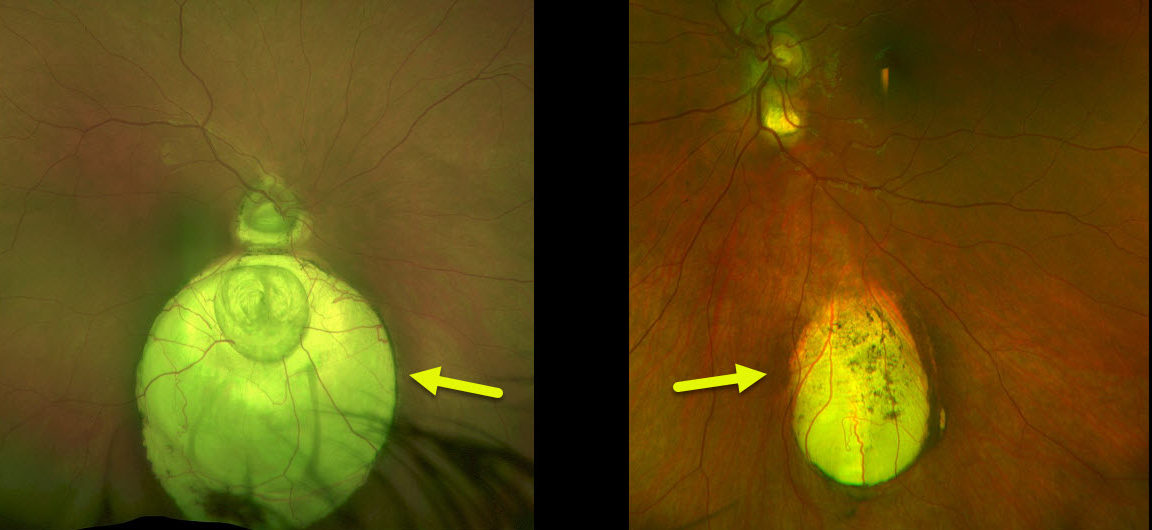
Our asymptomatic patient is being followed yearly for bilateral choroidal colobomas.
These patients are at risk for retinal detachment and choroidal neovascularization. Choroidal neovascularization has an increased tendency to develop at the superotemporal edge of the coloboma, which is thought to be caused by the abnormal architecture of the RPE and Bruch’s membrane.
Learning Points:
Choroidal colobomas are caused by failure of the optic vesicle and choroidal fissure to close during fetal development. Choroidal coloboma can present as solitary or multiple lesions as in this case. Visual prognosis depends on the location and involvement of the optic nerve and macula.