

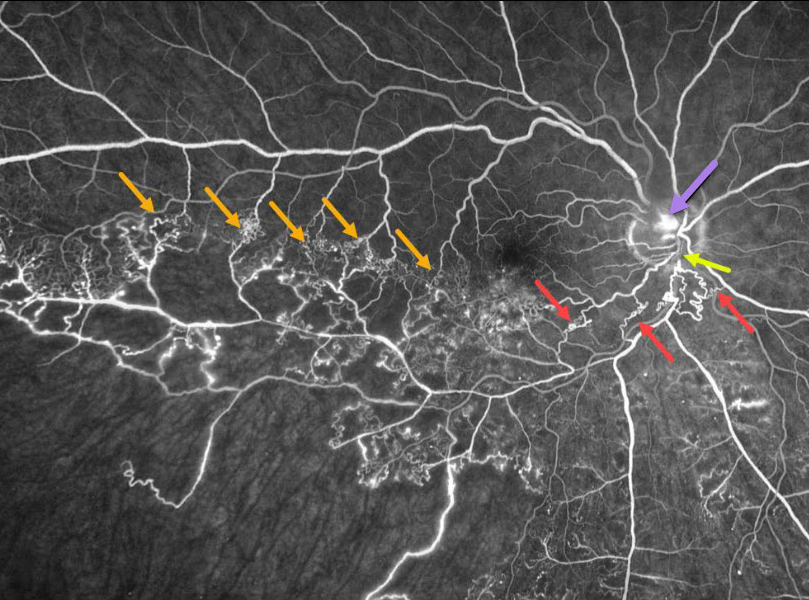
This patient has an ischemic branch retinal vein occlusion (BRVO) with extensive collateral vessels.
Occlusion occurs when an artery compresses the underlying vein where the vessels share a common adventitial sheath. Extensive collateral vessels cross the temporal horizontal raphe as well as around the occlusion more posteriorly. A small area of disc neovascularization leaks.
Learning Points:
Collateral vessels are dilated, pre-existing vessels that bypass an occlusion. These are most commonly seen in the posterior pole following retinal venous occlusions, but can also occur on the optic disc with optic nerve meningiomas.
The endothelial tight junctions are intact, so there’s no leakage on angiography. This helps differentiate them from neovascularization, which does leak.