

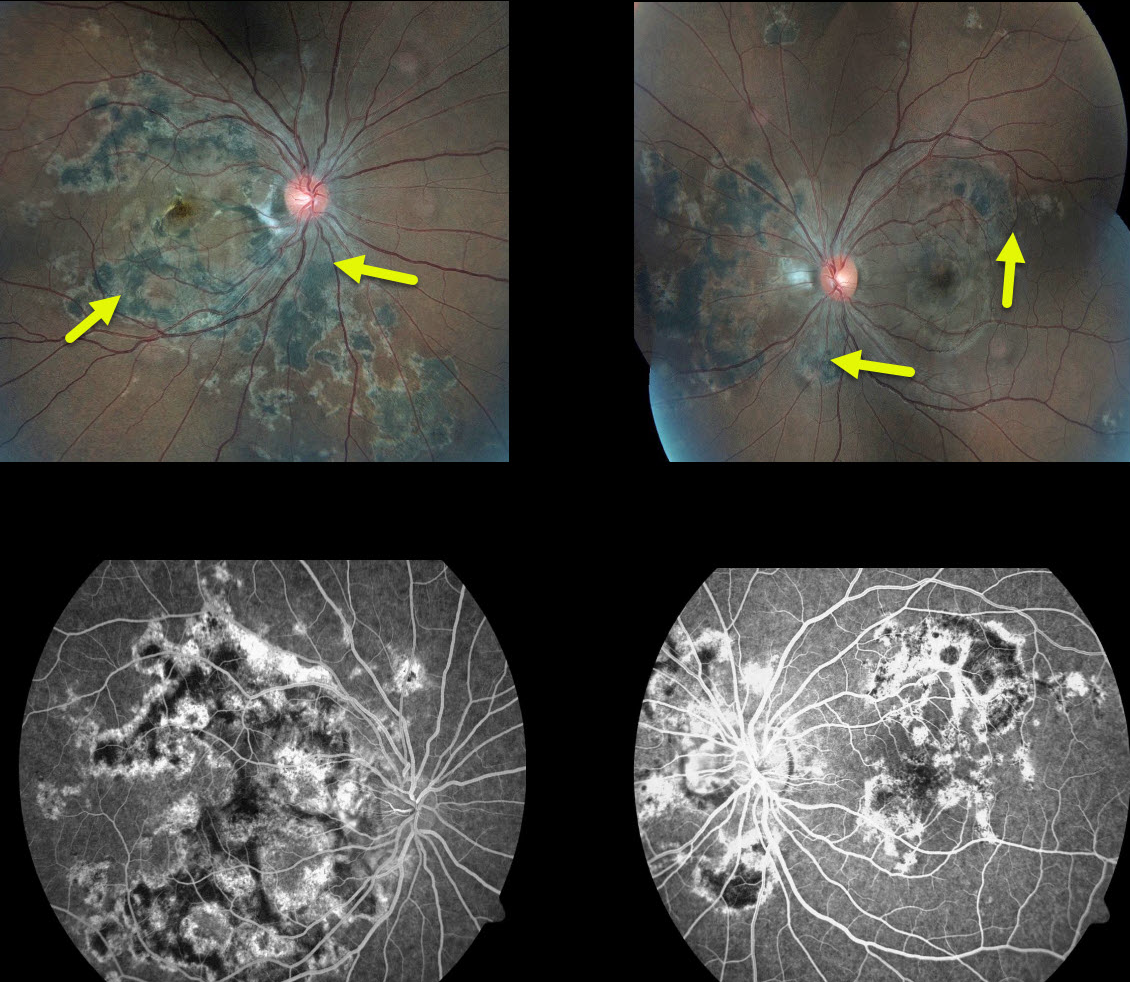
Our patient has relentless placoid chorioretinitis with the multifocal lesions of acute posterior multifocal placoid pigment epitheliopathy (APMPPE) and the peripapillary changes of serpiginous choroiditis.
This patient demonstrates chorioretinal scars surrounding the optic nerve but also throughout the posterior pole. Additionally, he has recurrent inflammation typical of serpiginous but not APMPPE.
His vision is 20/20 OU, which worsens when steroid or anti-inflammatory treatment is tapered. Infectious and inflammatory blood work was negative. He is currently treated and stable with methotrexate.
Learning Points:
Relentless placoid chorioretinitis has clinical and angiographic features resembling both serpiginous chorioretinopathy and acute posterior multifocal placoid pigment epitheliopathy (APMPPE).
Patients with relentless placoid choroiditis can develop recurrent inflammation and macular neovascularization that is more typical of serpiginous than APMPPE.
APMPPE is a bilateral inflammatory vs ischemic disorder of the inner choroid, RPE, and outer retina. These patients present with blurred vision and paracentral/central scotomas often following a viral illness.
Acutely, there are multifocal creamy yellow or grayish-white subretinal placoid lesions scattered throughout the posterior pole.
The lesions and visual symptoms usually resolve within 4 to 8 weeks with secondary chorioretinal changes. Recurrent lesions are rare, and vision is usually fairly good.