
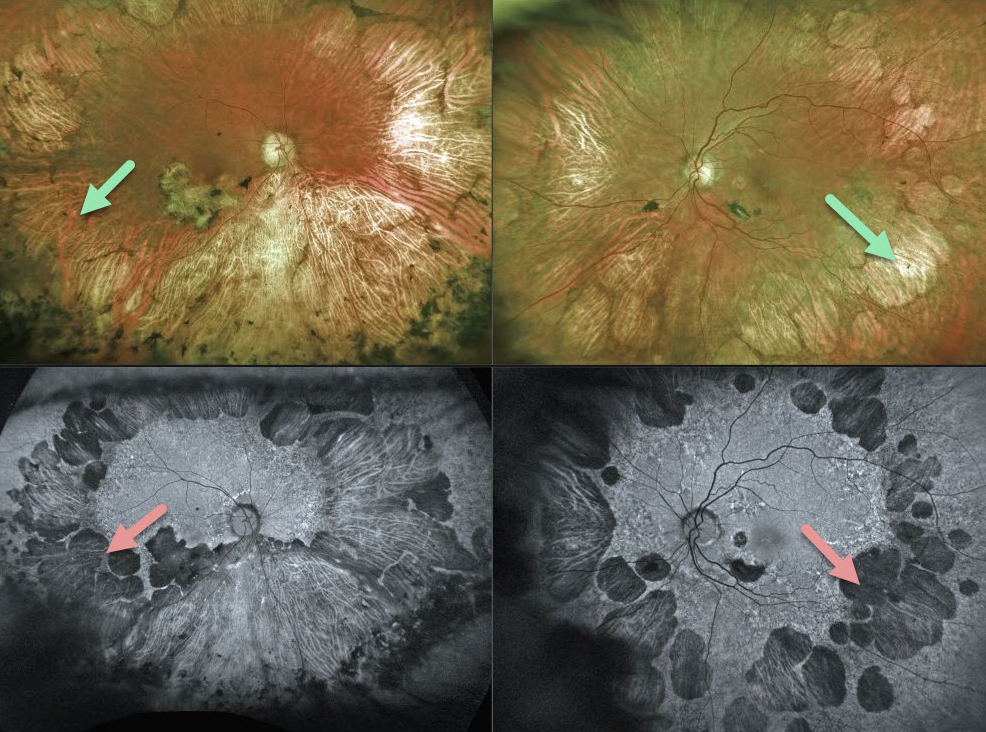
This 88YO female presented with 20/200 vision OD and 20/50 vision OS. Although she complained of nyctalopia since childhood, her vision was good throughout her life up until about a year ago. There was no family history of eye disease.
She had bilateral large islands of scalloped chorioretinal atrophy throughout the mid-peripheral fundi, with extension more posteriorly and inferiorly in the right eye. The areas of chorioretinal atrophy are hypoautofluorescent.
Learning Points:
The history of night blindness with scalloped areas of atrophy is consistent with gyrate atrophy, although patients usually progress to much more severe macular atrophy and vision loss.
Our patient may also have late-onset retinal macular degeneration (LORMD or LORD), which is a rare autosomal-dominant mutation in the tumor necrosis factor-related protein 5 (C1QTNF5) gene, which is expressed in the RPE. LORMD/LORD presents in the fifth to sixth decades with bilateral night blindness and drusen-like deposits throughout the fundi. Islands of atrophy, resembling gyrate atrophy, develop over time.
We will likely order plasma ornithine levels, which should be elevated if she has gyrate atrophy. Regardless of the etiology, however, no treatment is indicated.