

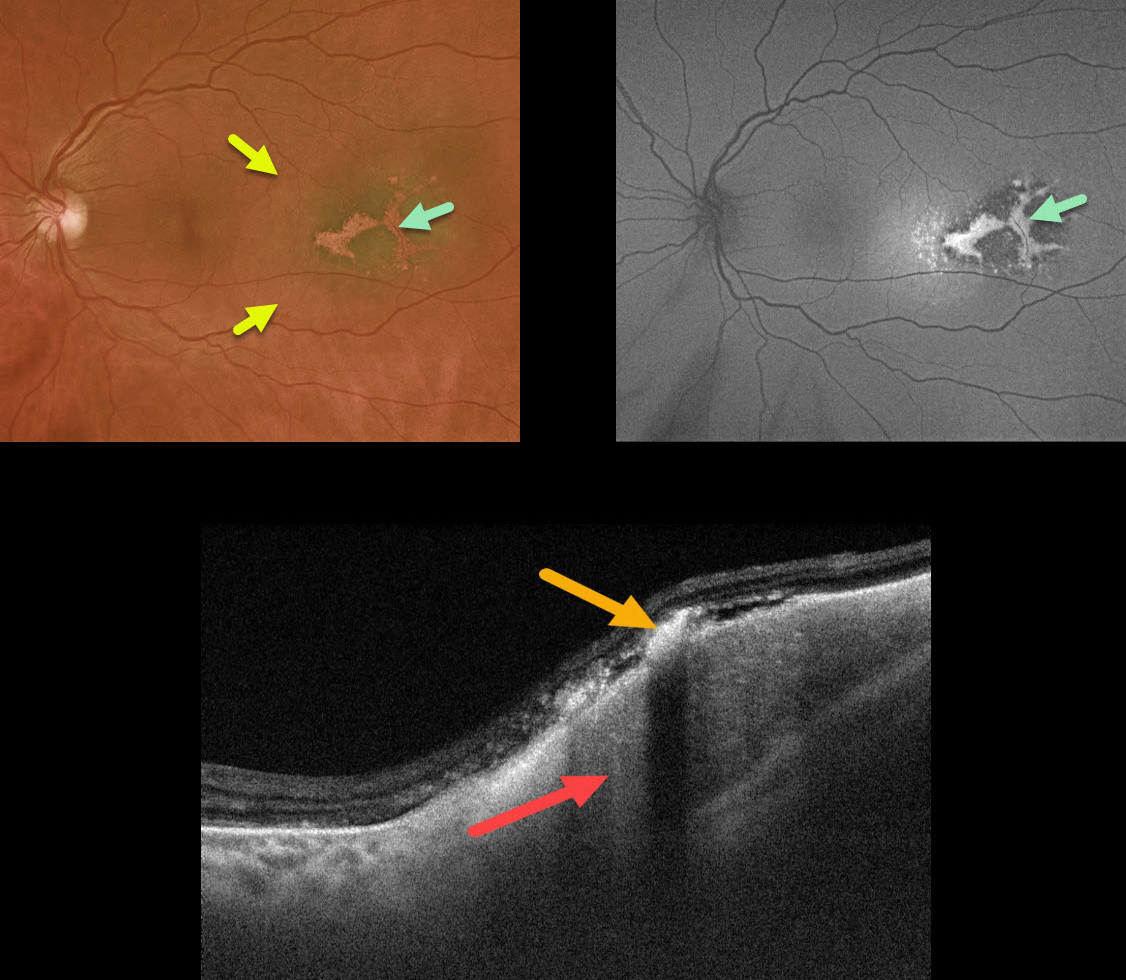
This 50YO female with a known history of cutaneous melanoma and renal cell carcinoma presented with a variably pigmented temporal macular lesion.
The lesion had an associated shallow serous detachment and overlying lipofuscin, which was hyperautofluorescent. OCT B-scan showed the choroidal mass with overlying hyperreflective lipofuscin.
Transpupillary thermotherapy was recommended, but external beam radiation will be needed if the lesion further enlarges.
We assume this lesion is a choroidal metastasis, but we are unsure of the primary cancer. We can also not rule out that this represents a primary uveal malignant melanoma (MM). Her oncologist is aware of this choroidal lesion, and she continues to receive systemic treatment for her renal cell carcinoma.
Learning Points:
Although uveal MM is the most common primary intraocular malignancy, metastatic choroidal tumors are the most common intraocular malignancies. Lung and breast cancer are the most common sources.
Uveal MM is usually not familial nor associated with systemic cancers. The BAP1 mutation is a recently recognized autosomal dominant syndrome with predisposition to uveal melanoma and other primary cancers, including cutaneous melanoma, renal cell carcinoma, and mesothelioma (see Singh et al, AJO 2021;224:172-177).
We spoke at length with the patient’s oncologist, and at least for now, he did not want to check for BAP1.