

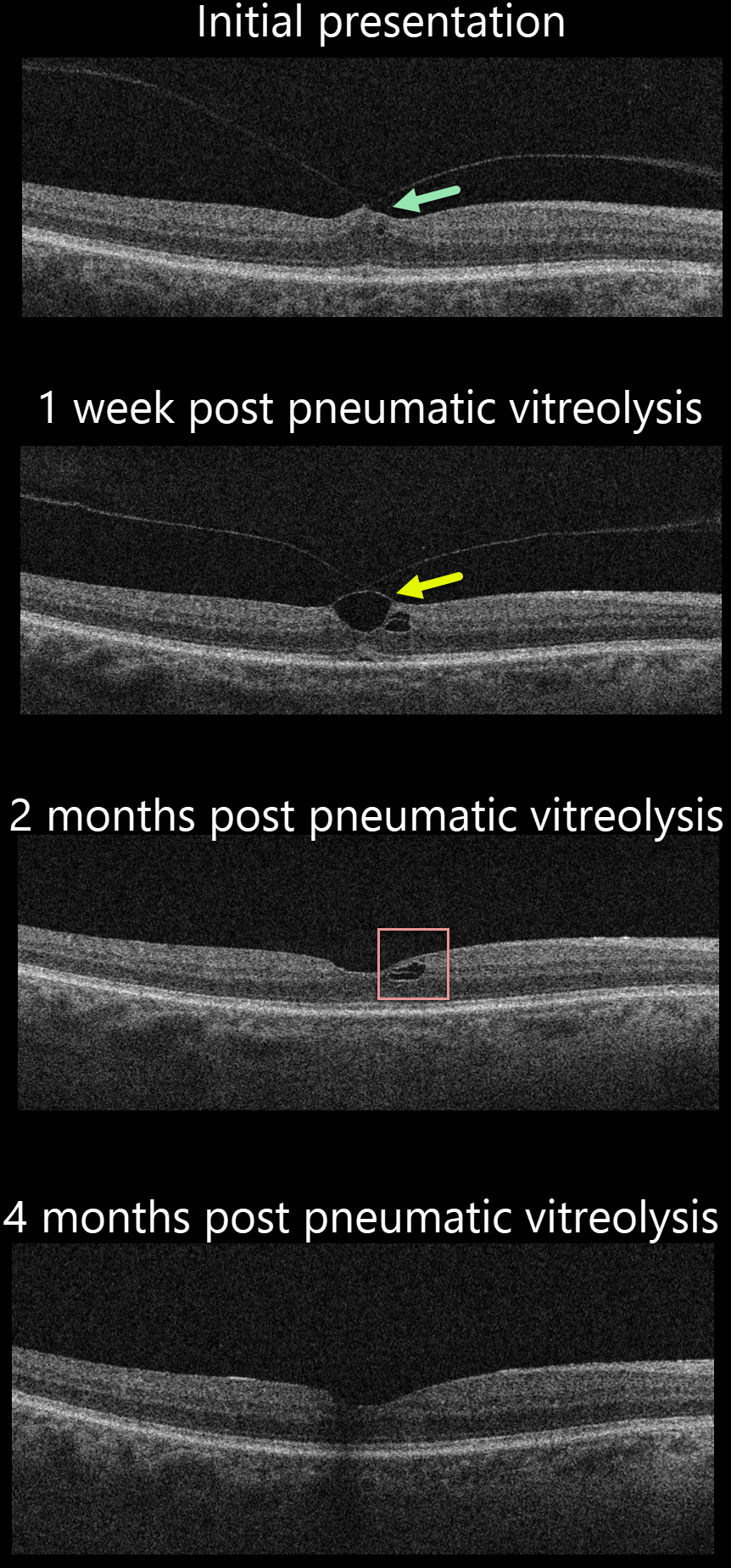
This 72YO male presented with symptomatic vitreomacular traction (VMT) and 20/40 vision. Various treatment options were discussed, including observation, ocriplasmin (Jetrea), pneumatic vitreolysis, and vitrectomy. He decided to proceed with pneumatic vitreolysis.
One week later, OCT showed that the vitreous remained focally attached to the central fovea, with increased traction.
Two months following the procedure, there was a complete vitreous detachment with normalization of the foveal contour and a small residual splitting of the outer plexiform layer nasally.
Four months following the procedure, OCT was virtually normal, and vision was 20/30. The patient was completely symptom-free.
Learning Points:
The prevalence of VMT increases with age and is present in about 1% of people over 40. The natural history is still being defined, but most patients have stable traction and vision. VMT can also resolve spontaneously in about 20% (Errera et al, Ophthalmology 2018;125:701-707).
Many patients with VMT remain completely asymptomatic despite impressive OCT findings. We therefore almost always observe VMT unless the patient has significant symptoms, as in this case.
Shortly after we treated this patient, the results of the DRCR Retina Network Protocol AG, which evaluated pneumatic vitreolysis with C3F8 for VMT, were published ahead of print (https://doi.org/10.1016/j.ophtha.2021.05.005). Gas successfully created a complete PVD in 78% of eyes. However, the study was terminated early due to safety concerns related to retinal detachment (8% of eyes). Based on these safety issues, we personally would no longer recommend this as a viable option unless medical issues make vitrectomy impossible.