

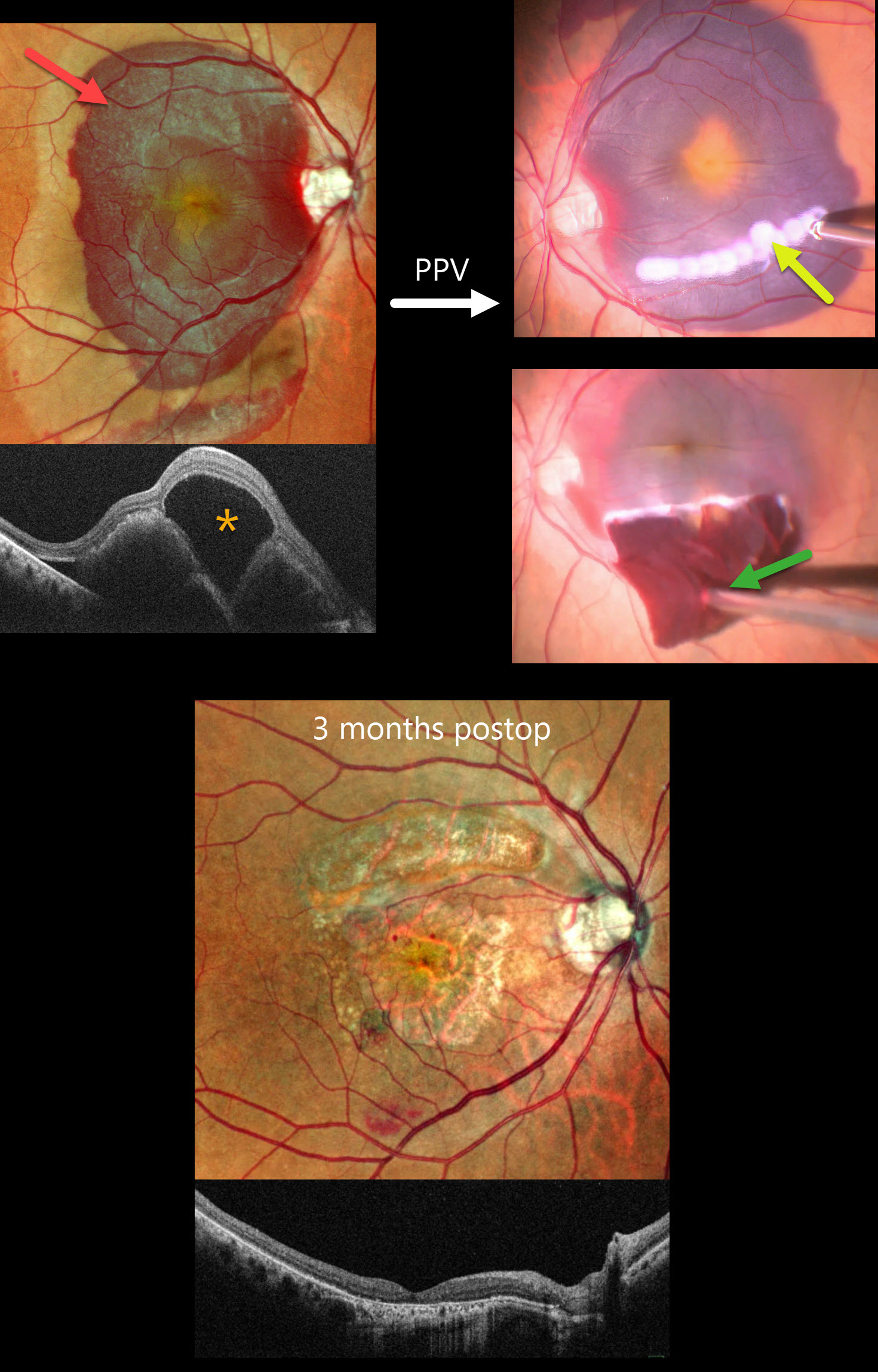
This 64YO female presented with 2 months of vision loss in her right eye. Vision was counting fingers OD and 20/30 in her normal OS.
Pseudocolor SLO imaging shows a large submacular hemorrhage. OCT scanning shows a central large bacillary layer detachment vs subretinal fluid overlying the elevated subretinal blood. Preoperative intravitreal tissue plasminogen activator (tPA) was injected, followed 2 days later by vitrectomy, a smile incision with excision of the subretinal clot, and gas tamponade.
Three months postoperatively, dry macular scarring is noted, and vision improved to 20/200.
Learning Points:
Common causes of submacular hemorrhage include neovascular age-related macular degeneration, polypoidal choroidal vasculopathy (PCV, our patient), trauma, and retinal arterial macroaneurysms. Multiple treatment options are available, including observation, anti-VEGF therapy, pneumatic displacement with positioning, and pars plana vitrectomy.
Surgery for thick submacular hemorrhage is often recommended due to the fear of possible toxicity from heme byproducts or fibrin formation (Toth et al, Arch Ophthalmol 1991;109:723-729). However, it is uncertain whether surgical results are better than anti-VEGF monotherapy (Gabrielle et all, Ophthalmology 2023;130:947-957). The value of adding TPA to any of these surgical options is also uncertain (Chotikkakamthorn et al, Retina 2025;45:394-401).