

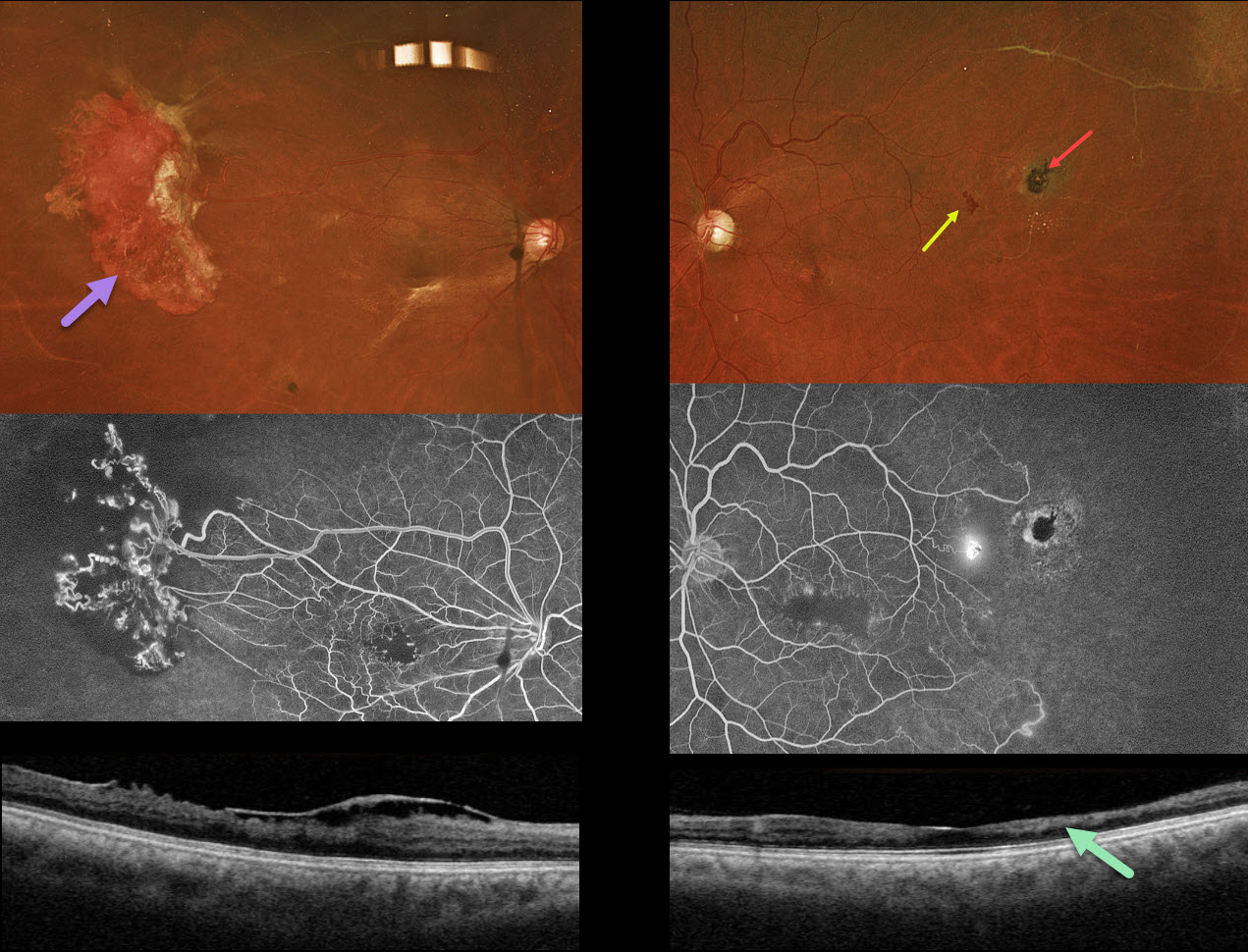
This 44YO male with a known history of sickle cell disease was referred for a possible detached retina. Vision has decreased over the past few years. Vision was 20/200 OU.
Optos color RGB imaging shows a large area of active neovascularization in the right temporal midperiphery associated with extensive angiographic retinal ischemia. Similar ischemia is noted OS with a small patch of leaking neovascularization. There is a small, more distal black sunburst lesion. The foveal avascular zones are enlarged with surrounding telangiectasia. This is reflected in bilateral inner retinal thinning with disorganization of inner retinal layers on OCT scanning (DRIL). An epimacular membrane is also noted OD.
Learning Points:
Patients with sickle cell disease develop symptoms throughout their bodies as stiffened, sickled red blood cells block capillary beds. In the eye, this can cause proliferative sickle cell retinopathy (PSR) with sea-fan-shaped areas of peripheral retinal neovascularization developing at the junction of perfused and ischemic retina. Increasing macular ischemia correlates with peripheral angiographic nonperfusion, as seen in our patient (Han et al., Ophthalmology Retina 2019;2:599-605). Complications include vitreous hemorrhage and tractional retinal detachment. Although patients with SS disease tend to have more systemic complications, SC disease is usually associated with more severe ocular findings.
Treatment with sectoral (Farber et al Arch Ophthalmology 1991;109:363-367) or circumferential (Kimmel et al Ophthalmology 1986;93:1429-1434) scatter laser photocoagulation is somewhat controversial since, unlike more typical proliferative retinopathies (ie from diabetes and branch retinal vein occlusions), these new vessels tend to auto-infarct with a good natural history for untreated disease (Downes et al Ophthalmology 2005;112:1869-1875). Based on the active appearance of the large temporal neovascularization OD, we elected for prophylactic scatter laser throughout the ischemic retina.