
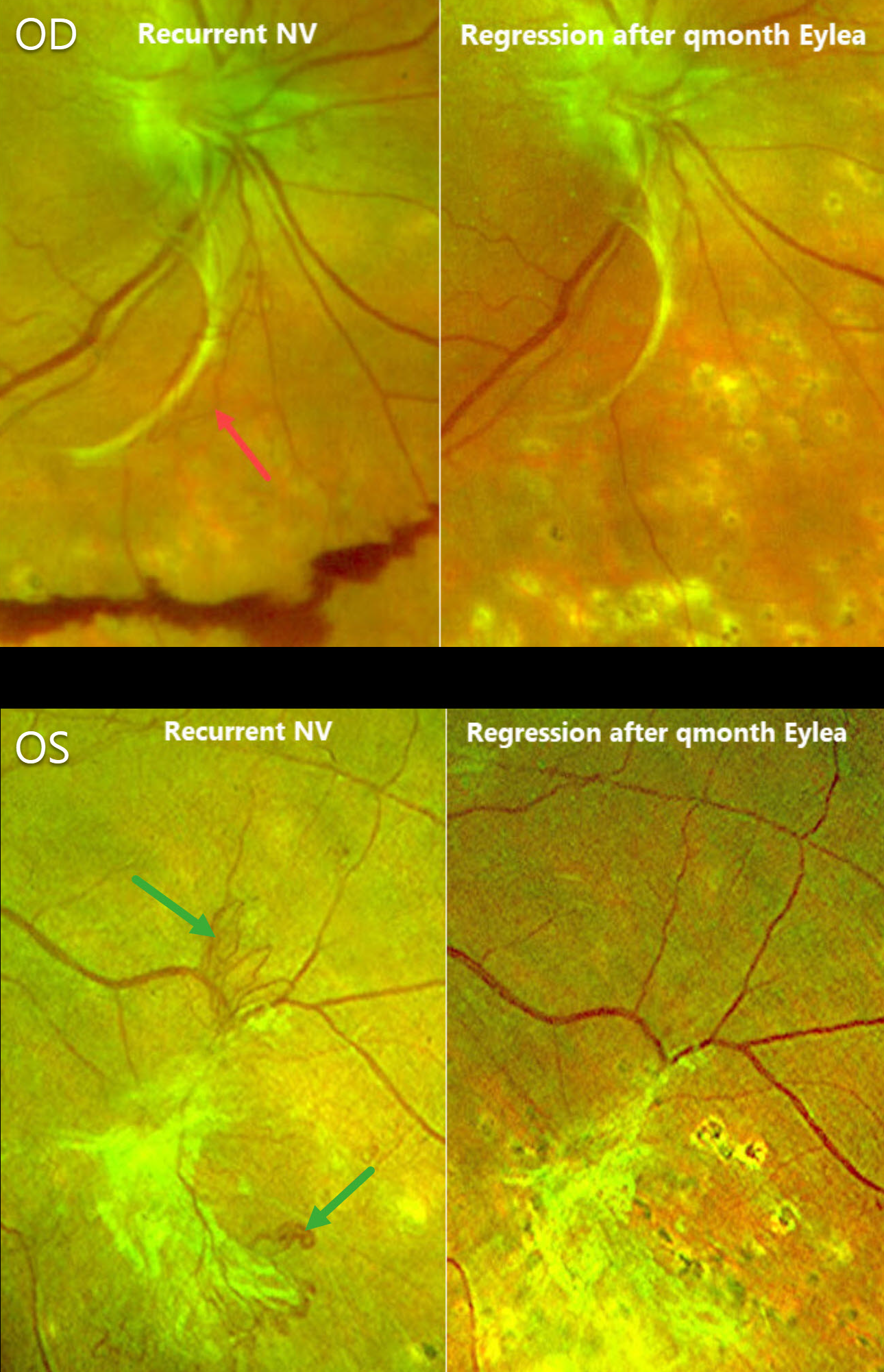
This 71YO female underwent prior full panretinal photocoagulation (PRP) bilaterally for proliferative diabetic retinopathy (PDR). She initially responded well with involution of all neovascularization. She presented for a routine follow-up with 20/25 vision OU.
Optos color RG imaging OD shows fibrosed disc neovascularization extending inferiorly with areas of active red neovascularization and inferior preretinal blood. The left eye shows fibrotic NV in the inferotemporal midperiphery along with some adjacent active vessels. Serial monthly bilateral Eylea injections were given, and 16 weeks later, the active NV fully regressed bilaterally.
Learning Points:
Although PRP is often considered a ‘one and done’ procedure, this is not always the case (Gonzalez et al, Ophthalmology 2021;128:1448-1457). Our patient is a perfect example of why these patients require lifelong monitoring even if their disease initially appears quiescent.
Prior to anti-VEGF therapy, our patient would have been treated with either additional fill-in PRP (putting her at risk for iatrogenic peripheral field loss) or possibly vitrectomy for increasing blood. Few currently advocate anti-VEGF injections as the sole treatment for PDR per the DRCR Protocol S. However, regarding adjuvant therapy to laser, we find these injections helpful for stabilizing macular edema or NV before starting PRP (Alsoudi et al, JAMA Ophthalmology 2024;142:972-975) and for those eyes needing supplemental treatment for active disease despite prior laser (Park et al, Eye 2021;35:3056-3063).