

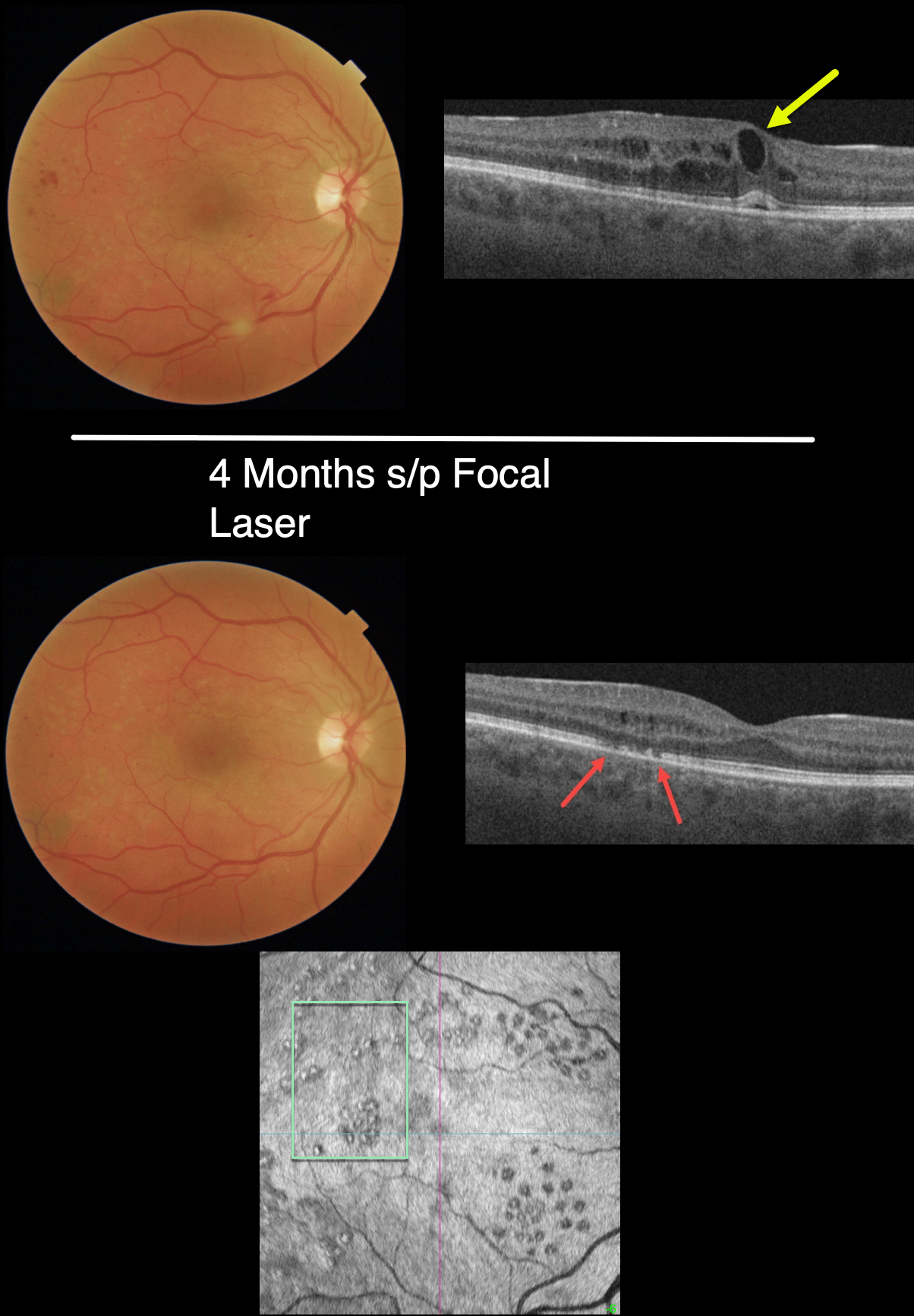
This 32YO female with type 1 diabetes was examined with no visual symptoms, and vision was 20/30 OD and 20/20 OS. Macular photography shows a foveal cyst and mild peripheral macular hemorrhages, and OCT scanning shows central and temporal cystic edema with trace subfoveal fluid.
Due to the lack of symptoms and good vision, we were hesitant to start anti-VEGF therapy, but due to concern for progressive, increased edema and vision loss, we decided to treat with macular laser.
Four months later, the edema virtually completely resolved. The laser scars appear as temporal defects in the ellipsoid zone, although they are barely visible funduscopically. The laser scars are more visible with outer retinal en face imaging.
Learning Points:
In their landmark 1985 paper (Arch Ophthalmology 1985;103:1796-1806), the Early Treatment Diabetic Retinopathy Study (ETDRS) introduced the term clinically significant diabetic macular edema (CSME). Broadly speaking, eyes with CSME, as determined by retinal thickening found on contact lens examination, have the threshold amount of macular edema that benefits from laser photocoagulation.
Macular laser remained the gold standard for diabetic macular edema (DME) for about 15 to 20 years. In the early to mid-2000s, a perfect storm brewed with the advent of OCT technology and intravitreal injections. Unlike lasers, which take many months to work and rarely significantly improve vision, intravitreal injections show a rapid and dramatic visual improvement, making them the mainstay for treating DME ever since.
CSME has become an antiquated term since we are now more concerned with whether the edema is central (central involved, CI-DME) or non-central (NCI-DME). Eyes with CI-DME are best treated with injections due to superior visual results.
However, our patient exemplifies why macular laser still has a place in any retinal surgeon’s toolbox, and should be considered a viable option for treating NCI-DME and even CI-DME when the leaking microaneurysms are outside the foveal avascular zone (FAZ). In our practice, macular laser remains the initial treatment for eyes with NCI-DME. When applied gently with small, low-power and short-duration applications well outside the FAZ, patients rarely, if ever, experience scotoma. Both the treatment burden and the financial costs to society are dramatically less. And there is no risk for endophthalmitis.
Although the role of thermal laser for treating DME is currently a source of debate (see Eye 2022;36:485-486 and Eye 2022;36:483-484 for great pro-laser and anti- laser editorials) we are not sure what all the fuss is about. Old-fashioned laser works and, in our opinion, is incredibly under-utilized.