

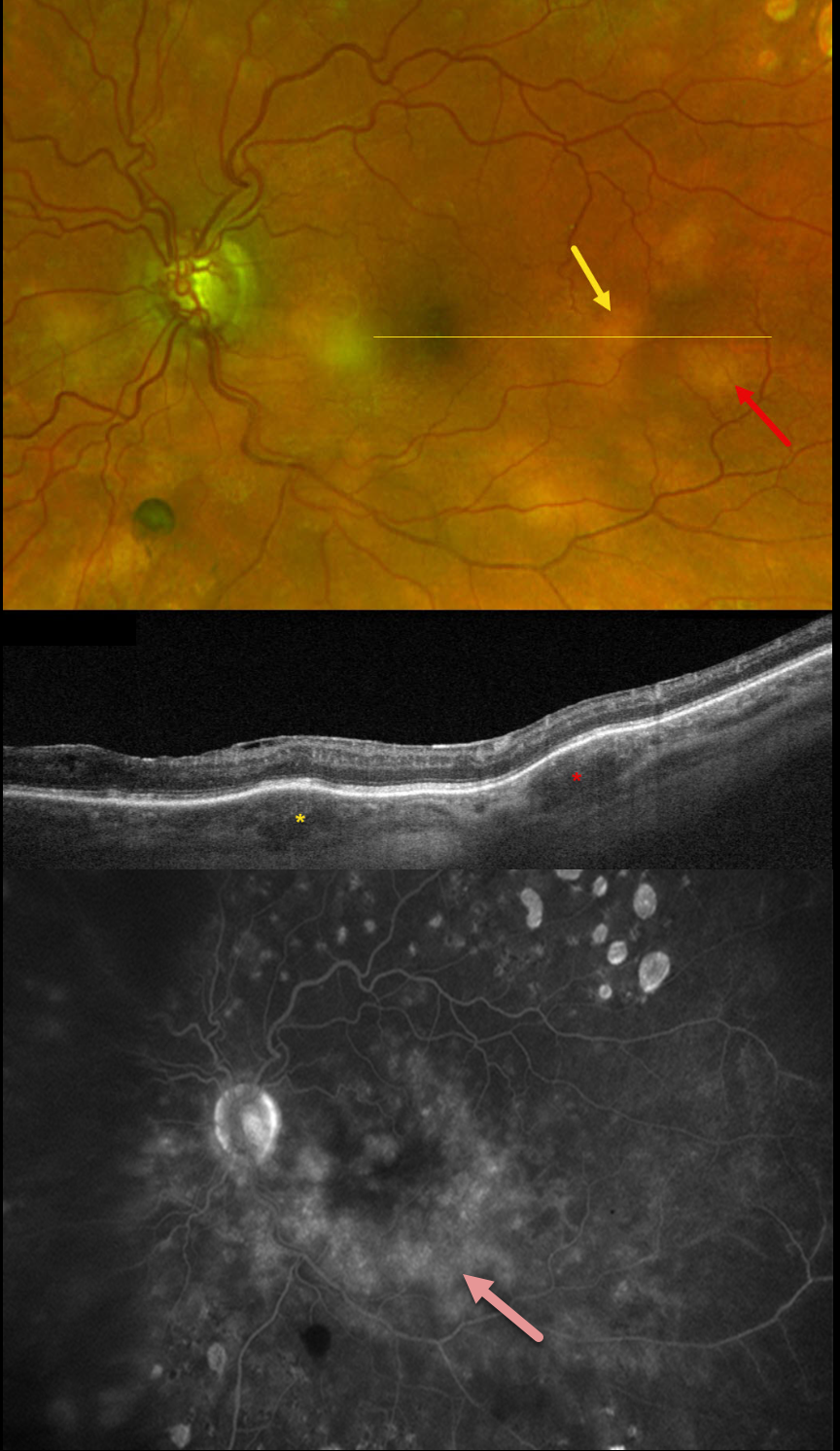
This 51YO male has a history of bilateral central retinal vein occlusions for which he has been receiving intravitreal injections. On examination on 12/21/23, vision was stable at 20/70 OD and 20/200 OS, with new elevated multifocal choroidal lesions noted bilaterally. Looking back through his prior imaging, these lesions were faintly evident 3 months earlier, but had rapidly grown since.
Optos color RG imaging of his left eye shows multifocal, elevated, creamy white temporal macula choroidal lesions. Triton swept-source OCT reveals these lesions to be hyporeflective. They show variable ill-defined staining vs leakage on fluorescein angiography.
The differential for these amelanotic choroidal lesions initially included choroidal metastasis, lymphoma, and granulomas. Extensive bloodwork, including ACE and lysozyme, was negative. Metastatic workup revealed mild splenomegaly and axial and mediastinal lymphadenopathy with a 5mm pulmonary nodule. Pulmonary biopsy showed noncaseating granulomas. Oral prednisone 60mg/day was started. When last examined on 4/12/24, vision remained at counting fingers, and his findings were relatively unchanged.
Learning Points:
Sarcoidosis, like syphilis, has a myriad of ocular presentations, including anterior, intermediate, and posterior uveitis, vasculitis, papillitis, and choroidal granulomas. Sarcoid granulomas are usually found as unilateral lesions without associated uveitis and appear as yellow choroidal lesions distinguished by an irregular, vermiform margin (Bas et al, Retina 2023;43:1842-1851). Granulomas are hyporeflective on enhanced-depth OCT imaging (Invernizzi et al, Retina 2015;35:525-531).
Establishing the diagnosis of ocular sarcoid in the absence of a known systemic diagnosis is often difficult. In our experience, chest CT is often positive despite negative bloodwork.
Given the negative metastatic workup and biopsy results, we assume the choroidal lesions represent sarcoid granulomas. These lesions have not significantly responded to prednisone. Pulmonary consultation agreed with our sarcoidosis diagnosis but suggested referring to rheumatology for help with getting the patient on a systemic steroid-sparing agent.