

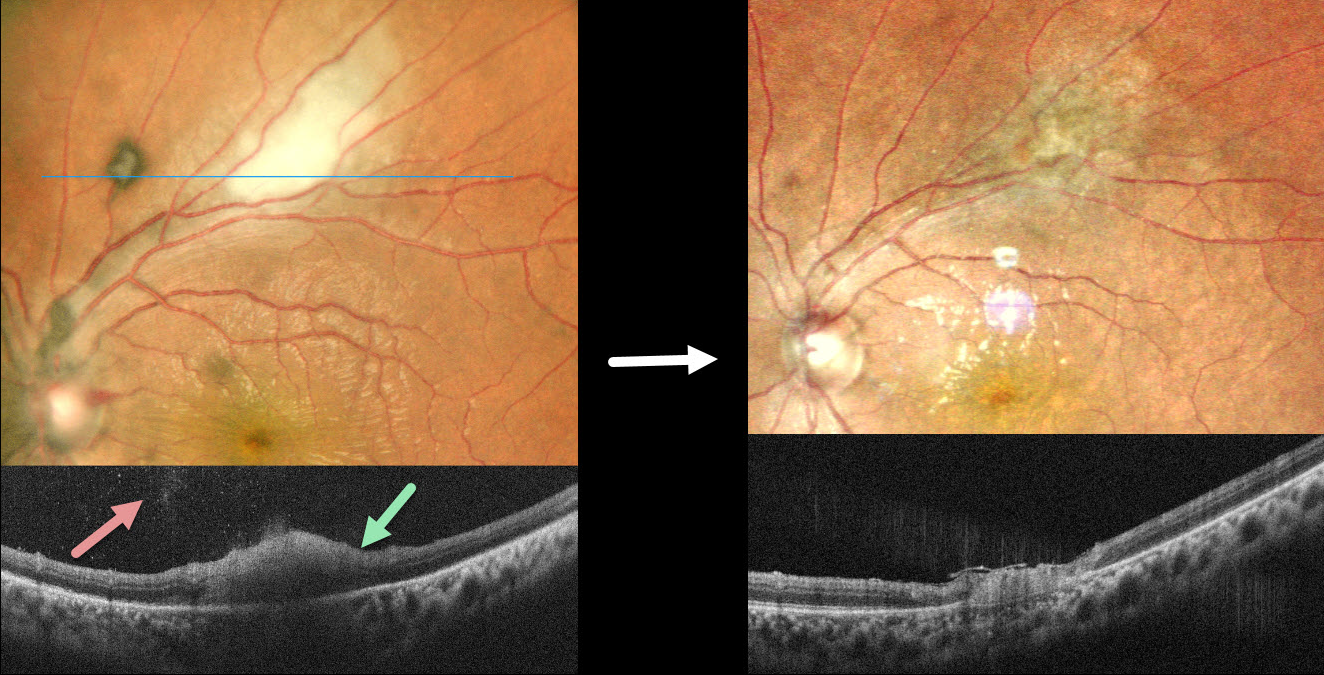
This 26YO male presented with 6 days of blurred vision in his left eye. Vision was 20/20 in his normal OD and 20/40 OS. The left cornea was edematous with a moderate nongranulomatous anterior uveitis and moderate vitreous cells. The intraocular pressure (IOP) was 47 mm HG.
Pseudocolor SLO imaging shows active white retinitis just superior to the macula. OCT scanning shows full-thickness hyperreflective retinal thickening with moderate overlying vitreous cells. He was diagnosed with toxoplasmosis panuveitis and started on a 6-week course of oral Bactrim DS. Oral steroids were also started 3 days later. The elevated IOP was aggressively treated with topical drops and oral acetazolamide. Six weeks later, vision improved to 20/30, and the IOP was 12. The uveitis and retinitis resolved, leaving behind inactive chorioretinal scarring.
Learning Points:
Toxoplasmosis, the most common cause of infectious chorioretinitis in humans, is caused by the protozoan parasite, Toxoplasma gondii. It is usually transmitted through infected felines or by eating raw meat. Most infections are acquired, although they can also be transmitted congenitally. The body’s immune system is unable to completely kill the organism, which often lies dormant within a chorioretinal scar for years. When the immune balance favors the encysted organism, active chorioretinitis develops. Focal retinitis usually develops adjacent to a pigmented retinochoroidal scar. Overlying retinal arterial vasculitis is not uncommon.
The inflammation usually resolves spontaneously within 6 weeks. If the optic nerve or macula is threatened, as in our patient, a six-week course of Bactrim DS is recommended (Soheilian et al, Ophthalmology 2004;112:1876-1882). Oral prednisone can be added as well to help with severe inflammation.