

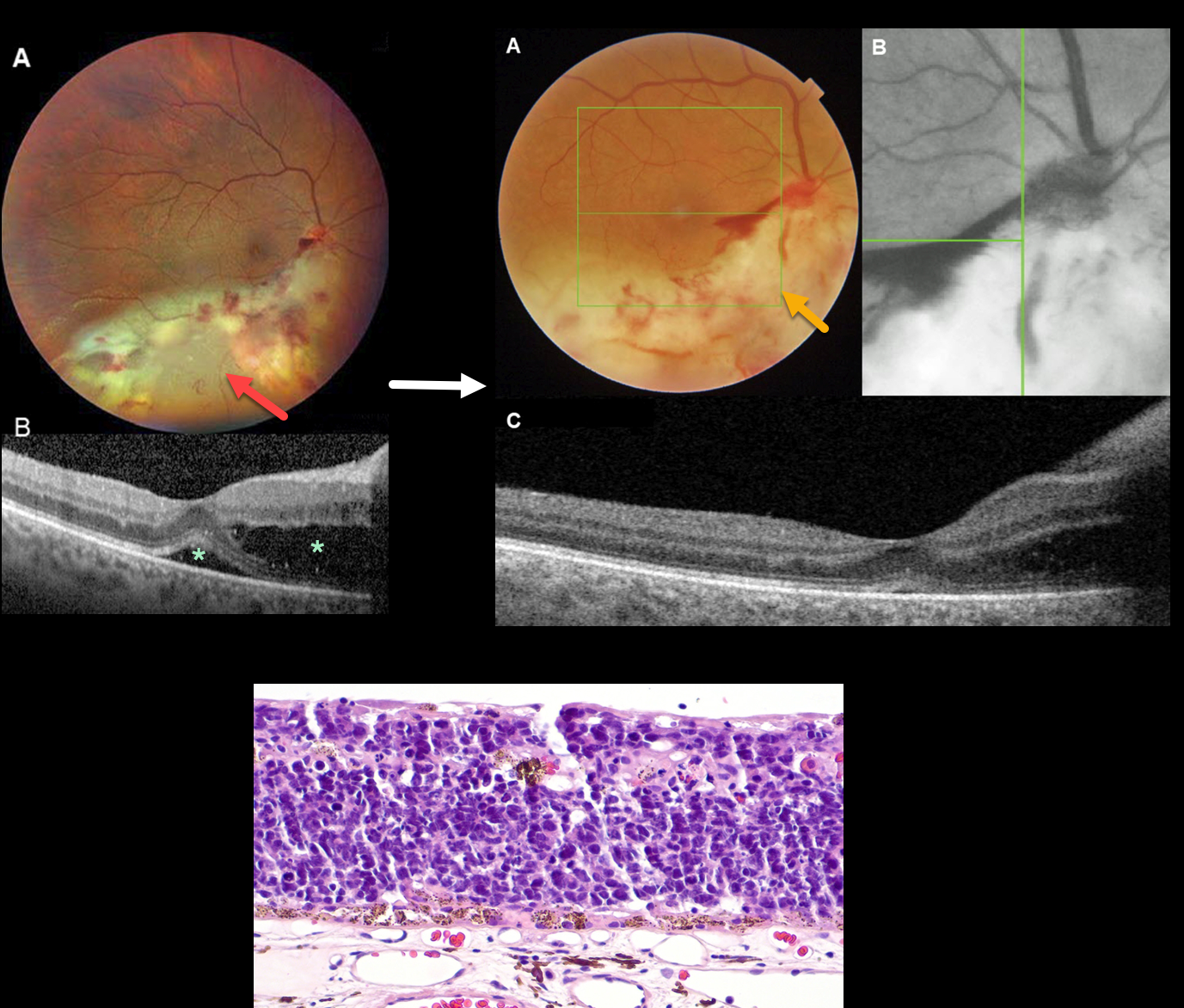
This 48YOF had a history of extensive-stage small-cell lung cancer (SCLC) with metastases to the thoracic and abdominal lymph nodes. She presented to an outside practice with a four-week history of a gradually worsening visual field defect and was diagnosed with cytomegalovirus (CMV) retinitis and started on oral ganciclovir.
She was then referred to a second practice for another opinion. Vision was 20/30. Color photography showed a yellow-white retinal lesion with associated retinal hemorrhages that extended from the inferior disc and macula to the inferior and inferotemporal periphery. The remaining peripheral retina and retinal vessels were unremarkable.
Although the fovea appeared spared clinically, optical coherence tomography (OCT) showed outer retinal fluid extending from the optic disc towards the fovea with mild subfoveal fluid. Intravenous and intravitreal Ganciclovir therapy was begun. Aqueous viral PCR testing was negative.
She was then referred to our practice. Vision was 20/40. The white retinal lesions now encompassed the entire optic nerve and nasal peripapillary region. Unlike what would be expected from treated CMV retinitis, the lesion mostly clinically spared the inner retina, had smooth borders, and lacked a central area of chorioretinal atrophy. Red-free imaging was suggestive of disc neovascularization. OCT scanning showed decreased outer retinal and subretinal fluid.
Vitrectomy was performed to obtain vitreous and retinal biopsies. Cytologic assessment of the retinal biopsy was consistent with the patient’s known history of SCLC.
After the discussion of treatment options, the patient chose to undergo systemic chemotherapy and enucleation of the right eye. Microscopic examination of the enucleated eye showed extensive areas of retinal replacement by a mitotically active small blue cell neuroendocrine tumor consistent with metastasis from the patient’s known extensive-stage SCLC.
Learning Points:
Lung cancer is the second most common worldwide cancer in both genders, with SCLC accounting for 13% of all newly diagnosed lung cancers. The prognosis is poor, and up to 50% of patients with extensive-stage SCLC have brain metastases (van Meerbeeck et al, Lancet 2011;378:1741-1755).
The retina is a very rare location for ocular metastases compared to the uvea and orbit. During a 40-year period, the oncology service at the Wills Eye Hospital observed only 8 (0.325%) retinal metastases compared to 2458 uveal and orbital metastases (Sheilds et al, JAMA Ophthalmol 2014:132:1303-1308).
The initial retinal findings can mimic viral retinitis, particularly CMV retinitis. Retinal metastasis should be considered in patients initially diagnosed with viral retinitis who fail to improve on adequate antiviral therapy, particularly with a known history of malignancy.