
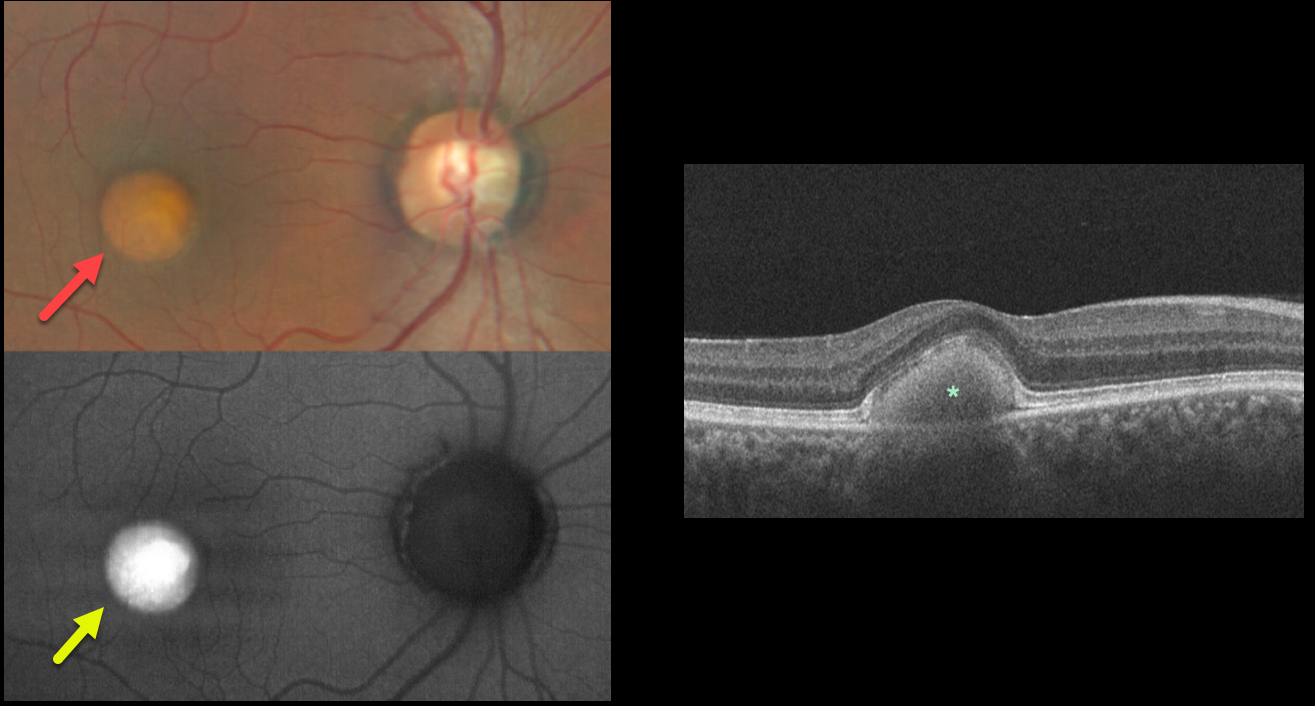
This 39YO male presented with these asymptomatic subretinal yellow posterior pole lesions. Vision was 20/30 OU.
The sharply demarcated yellowish lesions are markedly hyper-autofluorescent. This vitelliform material is hyperreflective on OCT. The subretinal material extends into and elevates the central retina.
Learning Points:
Best disease is associated with a mutation in the BEST1 gene, which encodes the bestrophin-1 protein.
Bestrophin-1, a calcium-activated chloride channel, is primarily found in the basolateral plasma membrane of the RPE. BEST1 mutations cause a variety of phenotypes, also including autosomal recessive bestrophinopathy, best vitelliform macular dystrophy, and autosomal dominant vitreoretinochoroidopathy.