
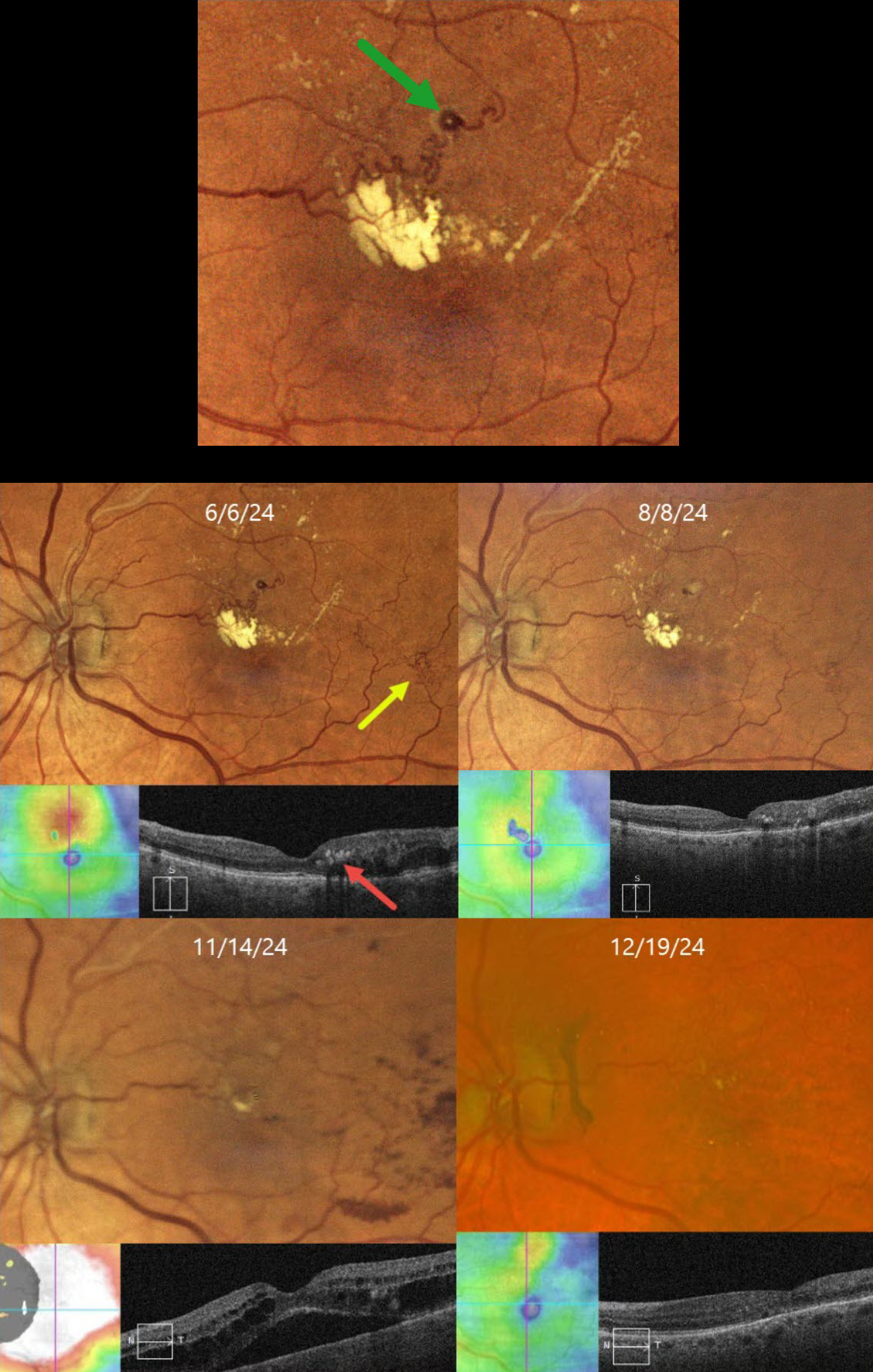
This 72YO female has been followed since 2017 for a branch retinal vein occlusion in her left eye. She has required ongoing anti-VEGF therapy for macular edema and failed macular laser for treatment burden several times. Although her eye was stable for years, on 6/6/24, there was new macular lipid with increased superior macular edema. Vision was stable at 20/25.
Color imaging shows a major superotemporal branch retinal vein occlusion with extensive collateral vessels and superior macular edema. Confluent lipid exudates threaten the macular center and appear as hyperreflective deposits in the mid-retina on OCT. A retinal venous macroaneurysm (RVM) is noted in the superior macula.
An intravitreal Eylea injection was administered, followed by focal thermal laser treatment of the RVM. Two months later, on 8/8/24, vision was 20/30. The lipid was decreasing, and the edema resolved. On 11/14/24, vision decreased to 20/60. Although the lipid was almost resolved, recurrent macular fluid persisted. Following a single Avastin injection, vision improved to 20/30, and the edema resolved. Macular grid laser was applied in hopes of reducing the treatment burden. We will continue to follow her closely and treat her as needed.
Learning Points:
In 1990, Cousins et al reported that RVMs can be an additional finding in occlusive venous disease, always in association with collateral vessels or capillary or arterial macroaneurysms (AJO 1990;109:567-570). These vascular abnormalities, also known as retinal capillary macroaneurysms or telangiectatic capillaries (TelCaps), tend to have a higher rate of intraretinal lipid (40%) but are less likely to affect central vision since they are usually outside the macula. They tend to have a higher association with retinal ischemia, thus being at a higher rate for developing retinal neovascularization (32%). Although these lesions will usually involute spontaneously, we treated our patient out of concern that the lipid might extend into the foveal center.