

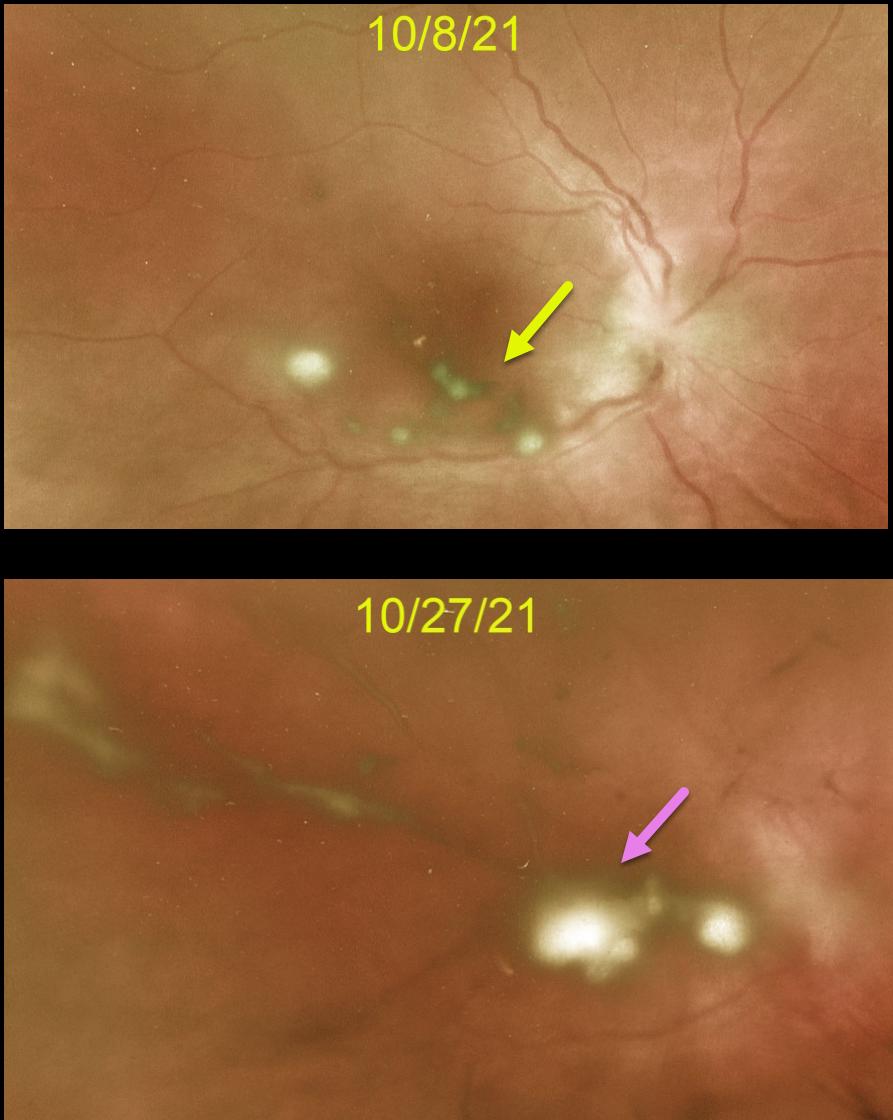
This 37YO male presented with a 4-day history of right eye pain and blurred vision. There was no prior ocular history, surgery, recent trauma, or intravenous drug use.
Vision was counting fingers OD and 20/25 in his normal OS. Moderate cell and flare were noted OD, along with a tiny hypopyon. Optos imaging shows multiple posterior inflammatory puff balls suggestive of endogenous fungal endophthalmitis.
We ordered emergent blood work to rule out other infectious causes before initiating intravitreal or systemic antifungal therapy. Unfortunately, he was completely noncompliant about going for testing despite daily calls.
He subsequently returned to the office 2 weeks later with increased vitreous opacities. On further questioning, he gave a history of recent low back pain and inflammation, where 6 weeks earlier he underwent surgery with metal plates. We told him to go to the ER for candida sepsis workup immediately.
However, he went home and continued his noncompliance, which finally led him to our local teaching hospital 1 week later. We assume the infectious source was the hardware implanted in his back.
Learning Points:
Ocular candidiasis is characterized by single or multiple focal yellow-white chorioretinal lesions with overlying vitritis, vitreous haze, vitreous abscess (fluff balls or string of pearls), and other more generalized presentations of infection and inflammation, such as endophthalmitis, hypopyon, scleritis, and anterior chamber cells.
Exogenous or endogenous sources can cause ocular candidiasis. Exogenous routes include trauma and inoculation from surgical procedures.
Endogenous ocular candidiasis arises from hematogenous seeding of the chorioretinal blood vessels caused by fungemia, indwelling catheters, severely compromised immune systems, and abuse of broad-spectrum antibiotics.
Treatment includes removal of the inciting source of candidiasis (e.g., an indwelling catheter) and systemic therapy, with possible intravitreal antifungal therapy.
Routine ophthalmic screening for known systemic candida sepsis is not recommended unless there are suggestive signs or symptoms for ocular involvement (see Breazzano et al, Ophthalmology 2011;129:73-76).