
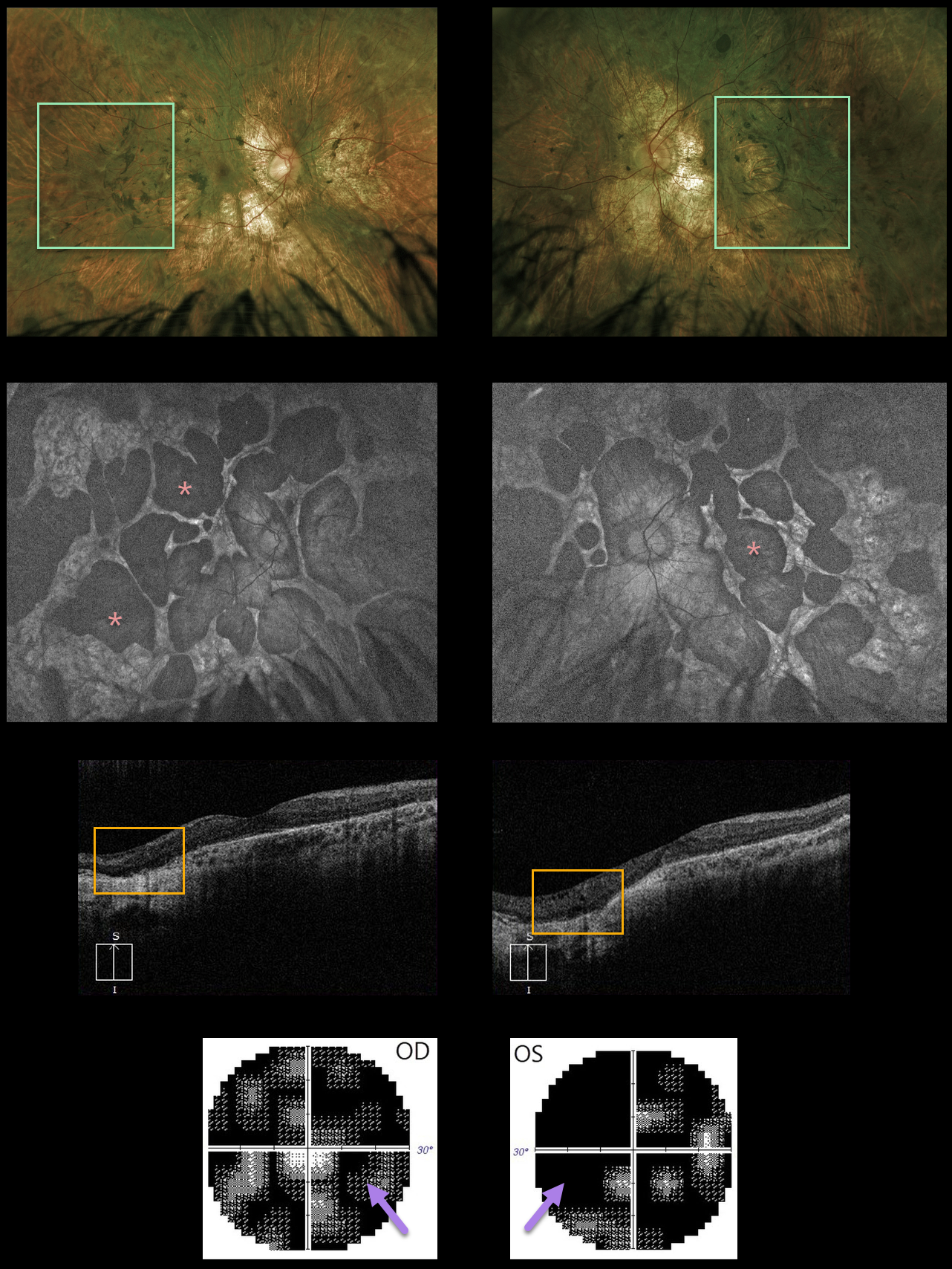
This 40YO female reported a 7-year history of reading difficulties and glare while driving at night.
Optos imaging shows severe diffuse chorioretinal scarring with intraretinal pigment migration extending from the optic nerves to the retinal peripheries.
The lobular nature of the chorioretinal changes is best seen with fundus autofluorescence. There was variable bilateral choroidal and outer retinal atrophy on OCT. Visual fields showed bilateral severe generalized depression.
Genetic testing showed that she was heterozygous for the pathogenic variant of the CHM gene. Vision remarkably was 20/20 OD and 20/25 OS due to sparing of the macular centers.
Learning Points:
Choroideremia is an X-linked recessive chorioretinal dystrophy caused by a mutation in the CHM gene located in the long arm of the X chromosome. Sons of female carriers have a 50% chance of developing choroideremia, and daughters have a 50% chance of becoming carriers. Some female carriers can still develop choroideremia due to irregular inactivation of the X chromosome (see Jauregui et al, AJO 2019;207:77-86).
Night blindness usually begins between the ages of 10 and 30, followed by peripheral visual field loss. Zones of patchy RPE and chorioretinal atrophy initially appear in the mid-periphery, gradually spreading anteriorly and posteriorly. Eventually, the patient is left with only a small island of vision, narrowed retinal vessels, and optic atrophy.
For a great choroideremia review article, see Pennesi et al, Retina 2019;39:2019-2069.