
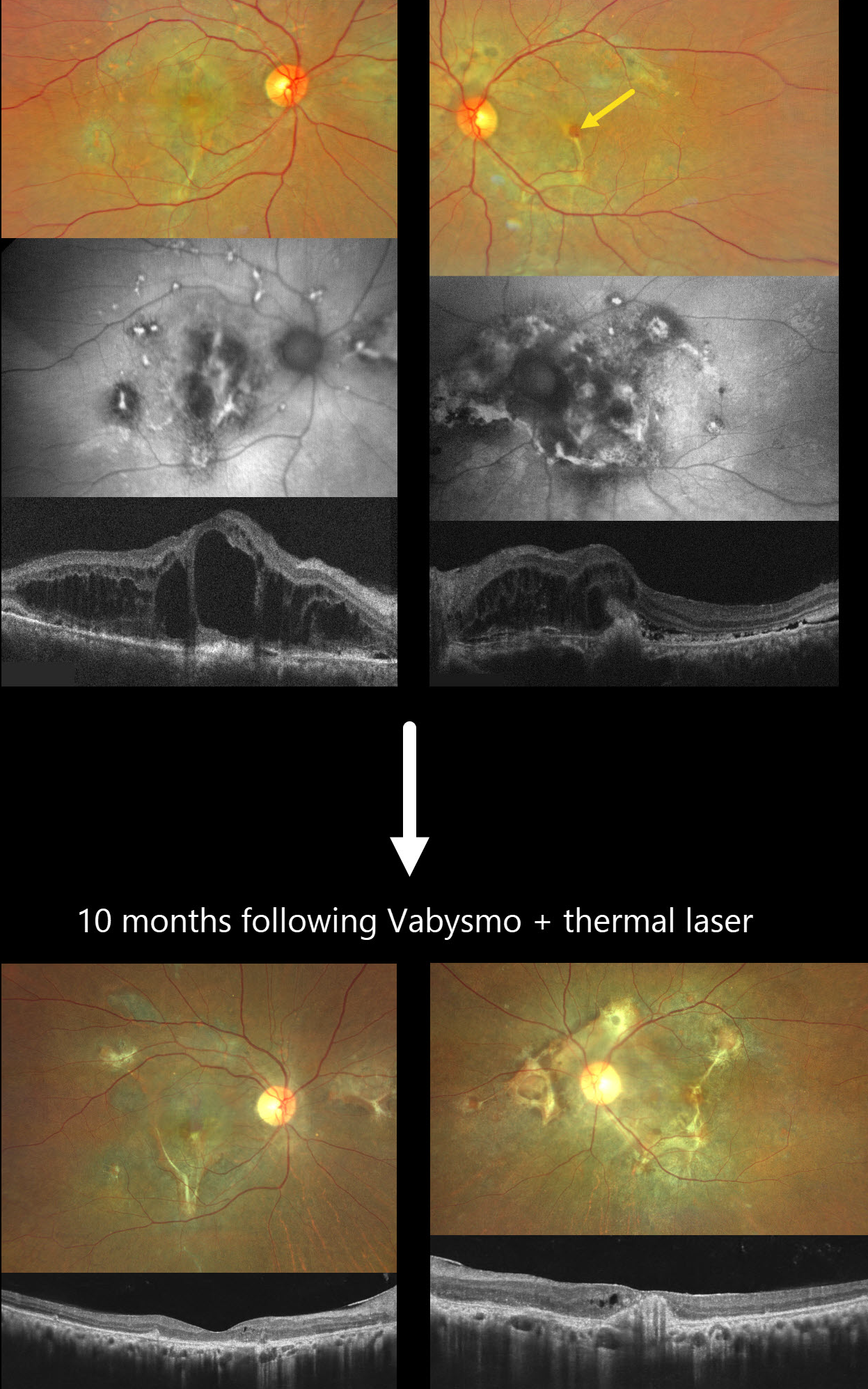
This 40YO male has a complex medical history of systemic lupus erythematosus (SLE) and interstitial nephritis, treated with chronic oral corticosteroids and hemodialysis. He presented with two weeks of bilateral vision loss of 1/60 OD and 2/60 OS.
Color photography shows extensive pigmentary changes and gutters consistent with chronic multifocal idiopathic central serous chorioretinopathy (ICSC). A blot of subfoveal blood is present in the left macula. An exudative detachment extended into the left inferior periphery. Fundus autofluorescence (FAF) shows hyper-FAF from more peripheral yellow-orange fleck-like lesions with hypo-FAF from scattered areas of chorioretinal scarring. OCT scanning shows marked outer retinal cystic edema OU with variable loss of the outer retinal bands. Shallow temporal subretinal fluid with hyperreflective material is noted OS. Fluorescein angiography shows multifocal bilateral subretinal leaks with a complex pattern of hyper- and hypofluorescence from the clinically evident pigmentary changes.
Two monthly Vabysmo injections for presumed macular neovascularization OS were administered, followed by a single session of bilateral thermal laser for multifocal subretinal leaks. When last examined 10 months later, vision was 3/60 OD and 6/24 OS, with complete resolution of all fluid.
Learning Points:
Our patient had severe and recurrent multifocal ICSC, most likely from chronic steroid use. There is a large body of literature supporting an association between endogenous and exogenous glucocorticoids and ICSC (Nicolson et al, Surv Ophthalmology 2018;63:1-8). One study estimated the risk of developing ICSC within 1 year of starting corticosteroids to be approximately 1 per 1000 (Rim et al, JAMA Ophthalmology 2018;136:1164-1169). In our experience, more severe disease, as evidenced by simultaneously active bilateral findings, multifocal subretinal leakage, bullous fluid, subretinal fibrin, multifocal gutters, and breakdown of the outer blood-retinal barrier with cystic retinal edema, is nearly always associated with corticosteroid use.
Despite photodynamic therapy (PDT) being the most effective ICSC treatment (Kim et al, Ophthalmology 2025;132:343-353), its use worldwide is limited by lack of availability outside the US and the false belief that mineralocorticoid antagonists or anti-VEGF injections are effective alternatives (Venkatesh et al, Int J Retina Vitreous 2023;9:61). Thermal laser photocoagulation appears to be a nearly forgotten yet still moderately successful treatment, especially where PDT is unavailable. It was quite effective in resolving our patient’s exudation.