
This 67YO female underwent a couching procedure for a left cataract in 2018. Cataract surgery with a posterior chamber IOL OD was performed in 2020, and 2 months later, the cataract surgeon referred her to us for evaluation of the couched lens OS.
Vision was 20/40 OS with a +10.00 diopter lens. She was lost to follow-up until she returned in March 2024 with counting-fingers vision OS. Her intraocular pressure was slightly elevated, and she had new focal lesions in the peripheral retina, which were felt to represent inflammation from leaking lens protein.
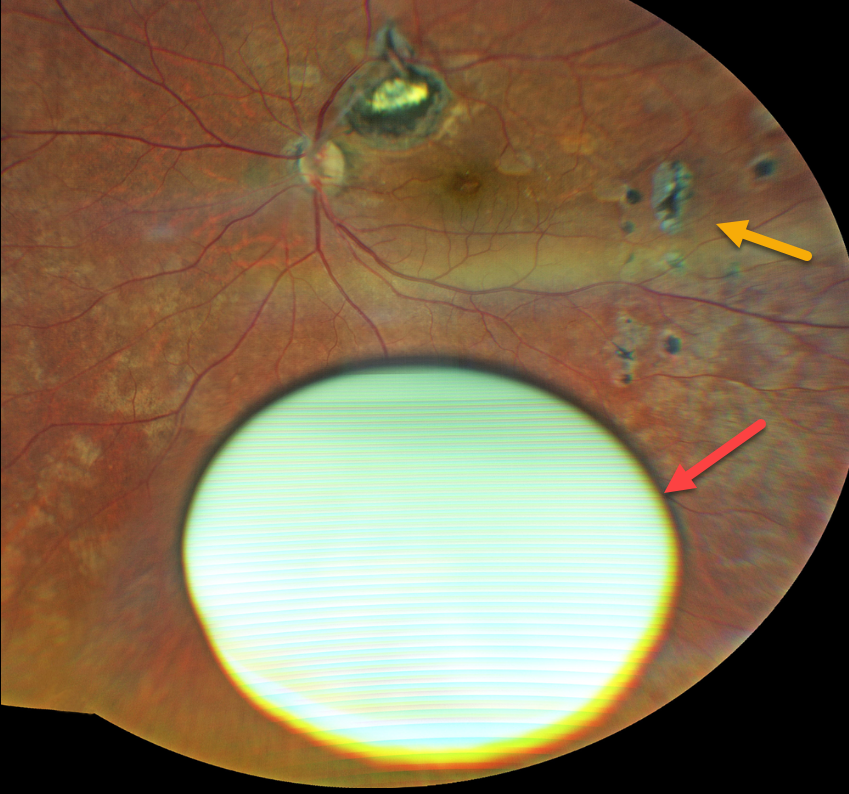
Fundus photography shows a dislocated intumescent hypermature cataract in the inferior vitreous. Multifocal chorioretinal scars are scattered throughout the fundus. Pars plana vitrectomy, lensectomy, and anterior chamber lens implantation were performed. Vision without correction was 20/200 OS one month postoperatively.
Learning Points:
Couching is the earliest documented form of cataract surgery and was widely practiced worldwide (Leffler et al, Ann Transl Med 2020;8(22):1551). It was described in 600-800 BC by an ancient Indian surgeon. This practice, though now largely abandoned with the advent of modern cataract surgery, is still rarely practiced in rural areas of some African countries, including Nigeria.
Couching is performed in the ‘comfort’ of the patient’s home by the ‘coucher’ who moves around in the rural community where their service is needed. The procedure involves using a sharp instrument to push the cataractous lens backward into the vitreous. If all goes well. A high hyperopic spectacle correction is prescribed. It can, however, be complicated by glaucoma, lens dislocation into the anterior chamber, cornea decompensation, uveitis, retinal detachment, vitreous hemorrhage, and intraocular infection.