
This 70 YO female presented with acute vision loss in her right eye starting 1 day earlier. Vision was 20/70 OD and 20/25 in her normal left eye.
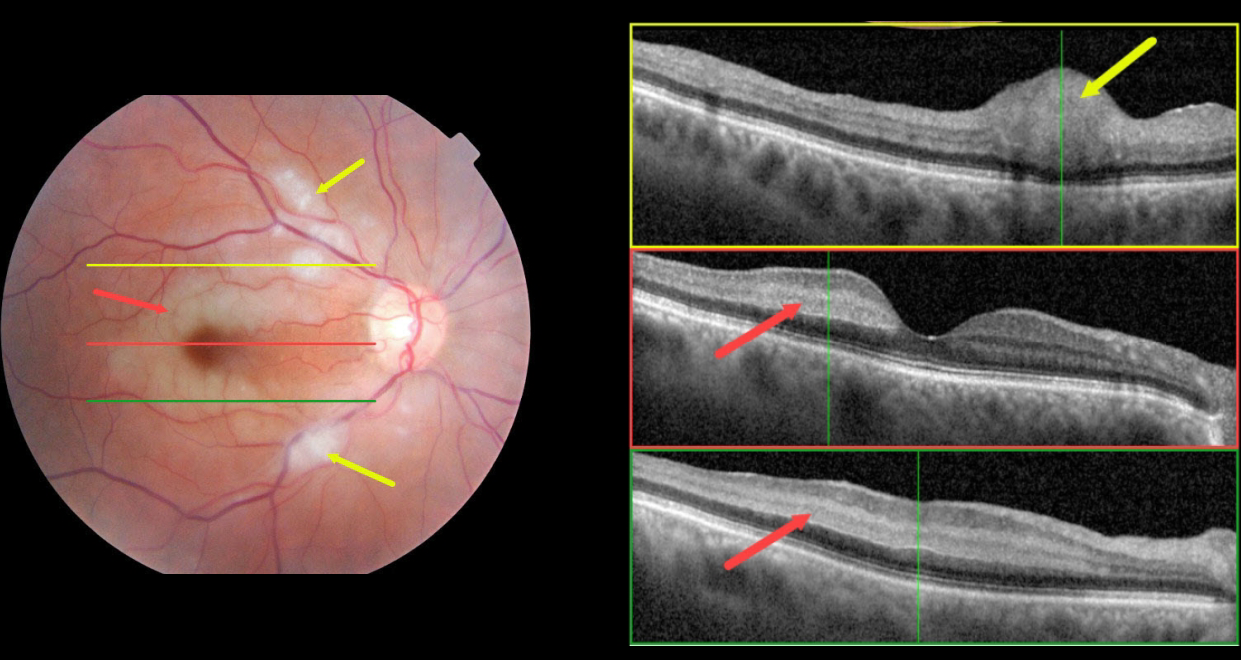
Color fundus photography shows an incomplete central retinal artery occlusion (CRAO) with focal areas of acute inner retinal infarcts along with paracentral areas of deeper retinal opacification.
OCT scanning through the superior macula shows a focal area of retinal opacification and thickening that extends from the outer plexiform layer to the internal limiting membrane. Scans of the central and inferior macula show hyperreflectivity involving the middle retinal layers (outer plexiform, inner nuclear, and inner plexiform).
Blood pressure was 183/110. Emergent stroke evaluation was fortunately negative. Her blood pressure was stabilized, and baby aspirin was started. Visual acuity improved to 20/30 one month later.
This case was submitted by Ryan Kern.
Learning Points:
Paracentral acute macular maculopathy (PAMM) is a phenotype caused by acute mid-retinal ischemia due to obstruction of the deep (DCP) and intermediate (ICP) capillary plexi. PAMM is associated with an increasing constellation of conditions, including retinal vein and artery occlusions.
It is unclear if patients with a pure PAMM phenotype require an immediate stroke protocol referral. In our practice, we have seen several elderly patients who developed a complete CRAO within days of presenting with PAMM, so we do send these patients for emergent evaluation. We do not believe that typical PAMM in younger patients or found as a secondary finding in other ocular conditions requires a stroke workup.
Our patient’s fundus appearance has more of a Purtscher ’s-like appearance with focal areas of cotton wool spot-like inner retinal ischemia (although on OCT these involved the middle retinal layers as well) and mid-retinal ischemia.
However, given her age and history, acute onset, and unilateral presentation, her diagnosis is most consistent with an incomplete CRAO.
For a great recent PAMM review, see Scharf et al, Progress in Retinal and Eye Research 2021;81;100884.