

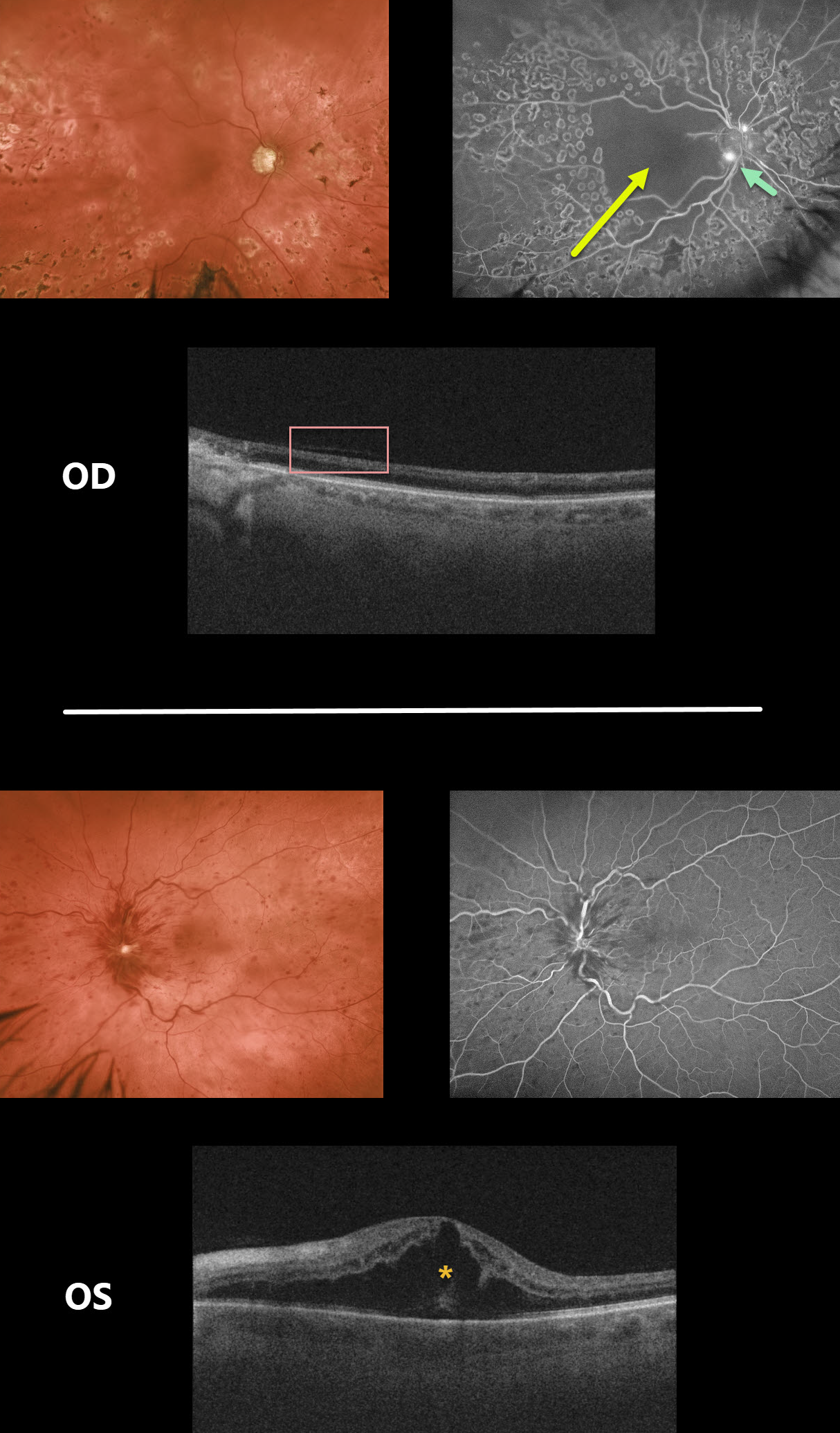
This patient had counting fingers vision OD due to a longstanding ischemic CRVO complicated by macular ischemia, disc neovascularization and neovascular glaucoma.
Fluorescein angiography shows profound capillary loss throughout the macula along with leaking disc neovascularization.
Due to the profound retinal ischemia there is marked OCT thinning of the inner two-thirds of the retina, giving a similar appearance to that seen with central retinal arterial occlusion.
She recently developed a new non-ischemic CRVO in her left eye with macular edema and 20/80 vision.
Learning Points:
This patient highlights several common and uncommon findings with CRVO. About 10% of patients will develop bilateral occlusions.
Eighty percent of occlusions are non-ischemic, although about one-third of these will convert to ischemic occlusions within several years. About 60% of ischemic occlusions will develop anterior segment neovascularization with neovascular glaucoma.
For some reason, posterior segment neovascularization rarely occurs (see the classic Hayreh 1983 paper Ophthalmology 1983;90;488-506).