

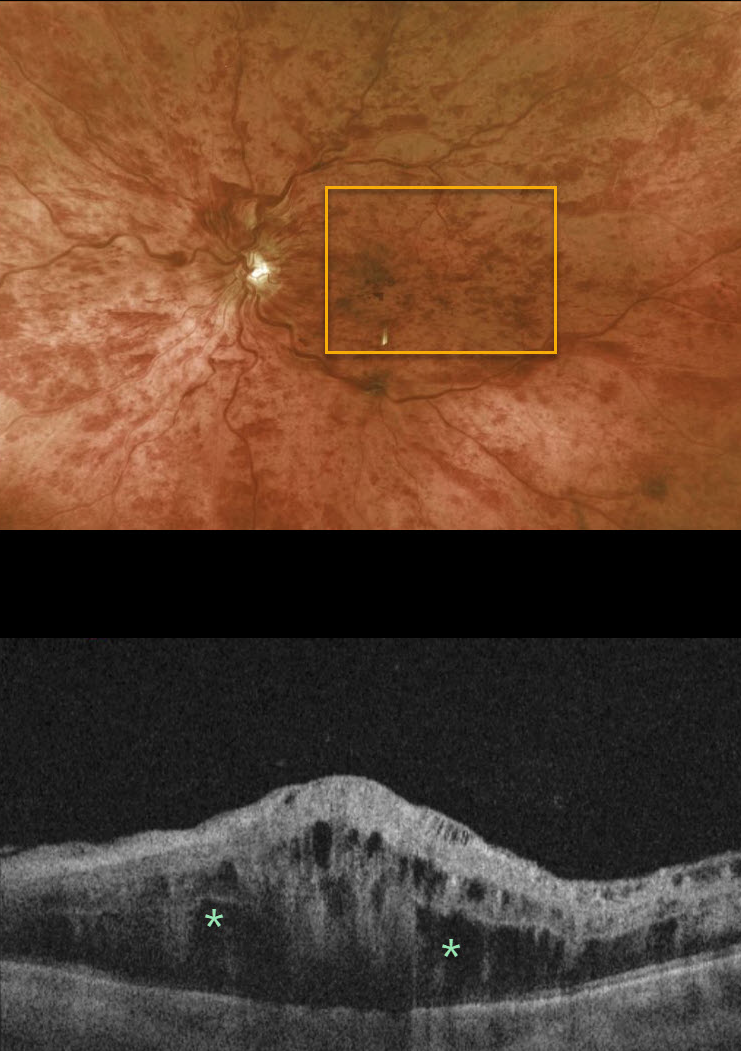
This 76YO male presented with 20/200 vision, the presence of an afferent pupillary defect, and extensive retinal hemorrhages. He had an acute ischemic central retinal vein occlusion (CRVO) with macular edema.
Patients with CRVO are at risk of vision loss due to macular edema or anterior segment neovascularization. Macular edema is common in both non-ischemic and ischemic occlusions, although rubeosis is found almost exclusively with ischemic occlusions.
Learning Points:
Intravitreal therapy in the early 2000s brought about the first successful treatment for CRVO-related macular edema. Anti-VEGF drugs are the first-line therapy, with the majority of patients gaining several lines of vision. Treatment is often ongoing, as it is for wet macular degeneration.
Although rubeosis was a common finding in the past (and is still seen if patients present with an untreated ischemic occlusion), this is now a rare occurrence since the vast majority of these patients have macular edema that is treated with ongoing anti-VEGF injections. Interestingly, if the injections are stopped several years later, rubeosis can still develop.
Iris neovascularization with neovascular glaucoma develops in about two-thirds of patients with untreated ischemic occlusions. Rubeosis is treated initially with an anti-VEGF injection, followed by aggressive, complete panretinal photocoagulation. Some patients will need a glaucoma tube or a cyclodestructive procedure if the IOP remains too high.