
This 53YO male came in for an initial examination since both of his sons and one of his nephews have been followed by us for years with familial exudative vitreoretinopathy (FEVR).
Both sons developed peripheral retinal neovascularization that responded well to scatter laser. Their father was visually asymptomatic.
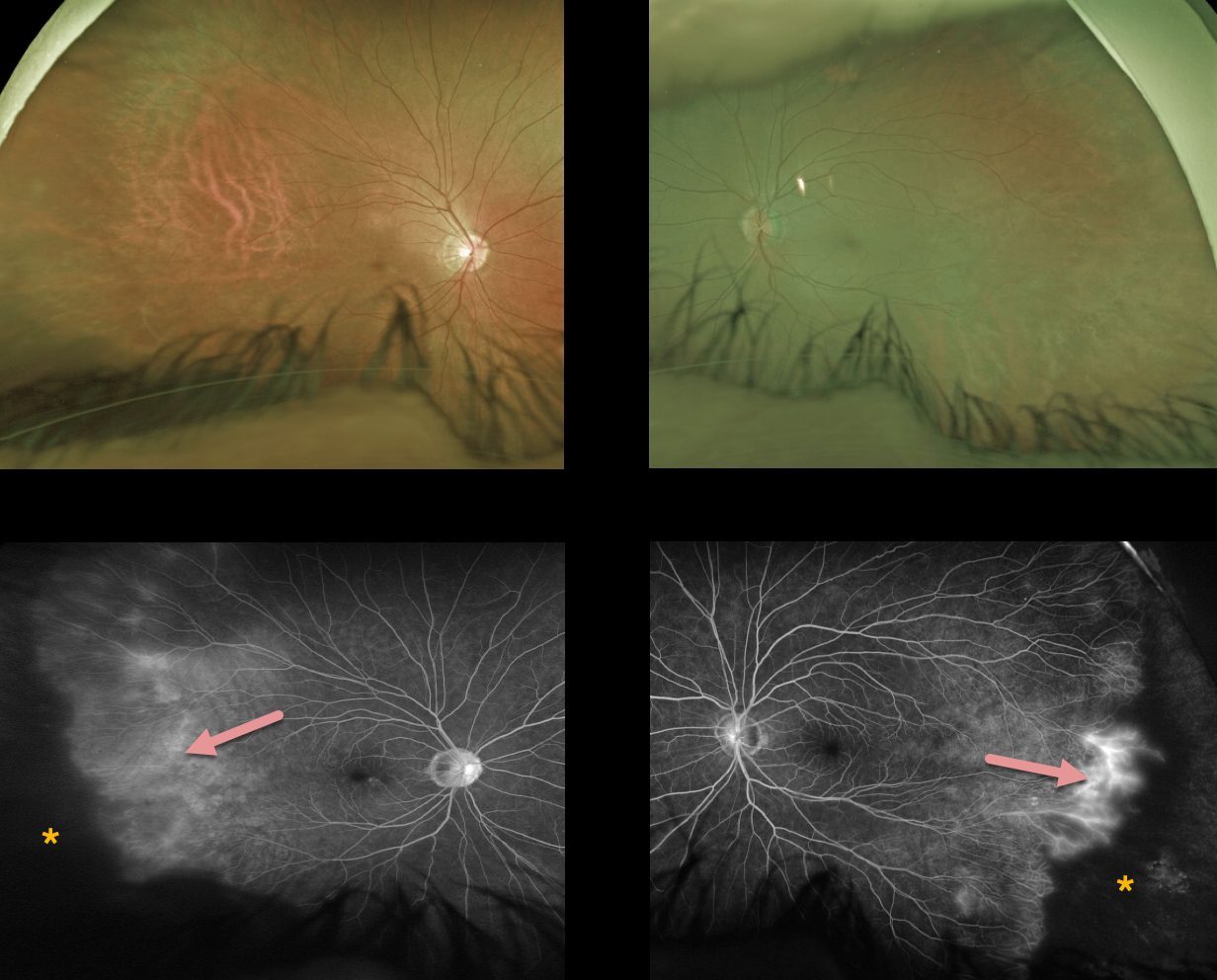
Optos color imaging shows normal posterior poles with featureless, ischemic temporal retinas. Fluorescein angiography shows marked bilateral peripheral temporal ischemia with leaking vessels at the border of the perfused and ischemic retina.
Prophylactic scatter laser to the ischemic retina was recommended to help prevent retinal neovascularization.
Learning Points:
Originally described by Criswick and Schepens (AJO 1969;58:578-594), familial exudative vitreoretinopathy (FEVR) can be inherited as an autosomal-dominant, recessive, or X-linked trait with high penetrance and variable expressivity.
FEVR is characterized by peripheral temporal retinal avascularity, lipid exudation, neovascularization, tractional retinal detachment, and temporal dragging of the macula and retinal vessels. These findings are somewhat similar to those found with retinopathy of prematurity (ROP).
Kashani et al found that peripheral retinal vascular findings are highly prevalent in asymptomatic FEVR relatives (Ophthalmology 2014;121:262-268), as was the case with our patient. They therefore recommended widefield angiographic screening in immediate relatives.