

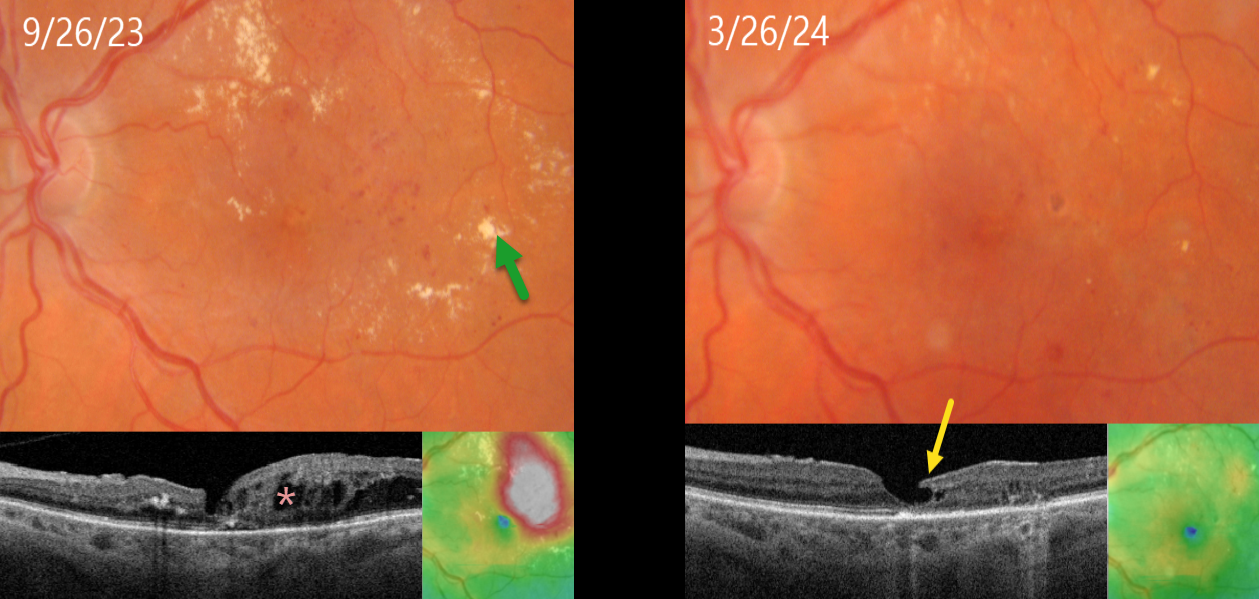
This 71YO female with type 2 diabetes presented diabetic macular edema (DME) and lipid exudates. Triton swept-source OCT shows central foveal thinning with surrounding cystic edema. Vision was 20/60. Thermal macular laser was applied.
Six months later, the edema completely resolved following this single treatment, with near total resolution of the macular lipid. A partial degenerative lamellar macular hole (LMH) is noted. Vision improved to 20/50.
Learning Points:
Our patient exemplifies why macular laser still has a place in any retinal surgeon’s toolbox and should be considered a viable option for treating non-central involved diabetic macular edema (NCI-DME) and even center-involved edema (CI-DME) when the leaking microaneurysms are outside the foveal avascular zone (FAZ). In our practice, macular laser remains the initial treatment for eyes with NCI-DME. When applied gently with small, low-power, and short-duration applications well outside the FAZ, patients rarely, if ever, experience scotoma. Both the treatment burden and the financial costs to society are dramatically less. And there is no risk for endophthalmitis.
Although the role of thermal laser for treating DME is currently a source of debate (see Eye 2022;36:485-486 and Eye 2022;36:483-484 for great pro-laser and anti-laser editorials) we are not sure what all the fuss is about. Old-fashioned lasers work and, in our opinion, are incredibly under-utilized.
LMH can be defined as tractional or degenerative (Govetto et al, AJO 2016;164:99-109). Our patient developed a partial degenerative LMH following likely degeneration or rupture of a foveal cyst following closure of the leaking microaneurysms. There is some debate regarding the benefits of surgery for symptomatic LMH, with some suggesting visual improvement (Morescalchi et al, Retina, 2020;40:1087-1093) and others noting little visual benefit (Mohammed and Thompson, J Vitreoretinal Diseases 2024;8:125-130). Since our patient was visually happy, observation was recommended.