
This 54YO female presented with a 9-month history of blurred vision in her left eye. She was on Elmiron (pentosan polysulfate sodium, PPS) for about 20 years due to interstitial cystitis, but stopped the medication before seeing us due to the widespread publicity about its potential retinal toxicity.
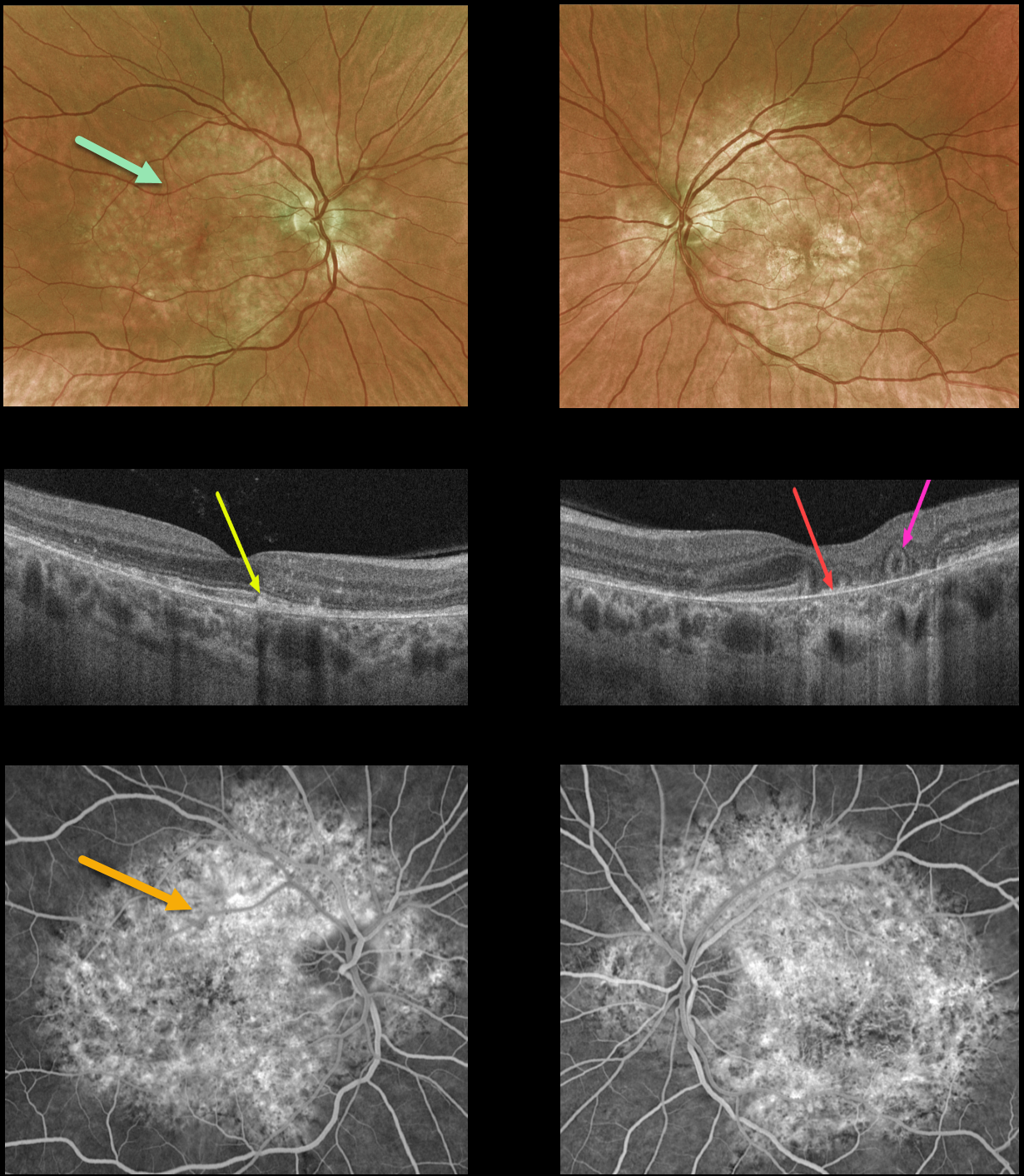
Optos color imaging shows variable yellow-orange atrophic pigmentary changes throughout the macular and peripapillary posterior poles.
OCT of the right macula shows scattered hyperreflective lesions mostly within the outer segment layers. The left macular OCT shows variable outer retinal and RPE loss, especially centrally, where bare Bruch’s membrane is visible. There is also an area of outer retinal tubulation (ORT) more temporally.
Fluorescein angiography shows window defects within these regions.
Learning Points:
Elmiron was approved by the FDA in 1996 for treating interstitial cystitis. Recently, a unique PPS retinopathy has been described, and our patient shows classic findings.
Toxicity seems to develop over many years and can mimic more common disorders, including age-related macular degeneration and macular dystrophies.
Peripapillary hypoautofluorescence, more densely packed macular autofluorescent changes, and earlier central macular involvement suggest PPS toxicity over other causes (see Barnes et al Ophthalmology Retina 2020;4:1196-1201), including maternally inherited diabetes and deafness (MIDD).
ORT is often noted overlying inactive macular neovascularization with ongoing anti-VEGF therapy and should not be confused with exudative fluid or cysts, which lack a hyperreflective border. The outer hyperreflective band likely represents inner segment mitochondria undergoing fission and translocation towards the nucleus (Litts et al, Retina 2018;38:445-461).
ORT, initially described by Zweifel et al (Arch Ophthalmol 2009;127:1596-1602), is a neurodegenerative condition of the photoreceptors and Muller cells associated with atrophy affecting the outer retina and retinal pigment epithelium, including advanced AMD and inherited retinal diseases.