
This 56YO phakic male presented with floaters and a football-shaped nasal shadow in his right eye for one week. Vision was 20/20 bilaterally.
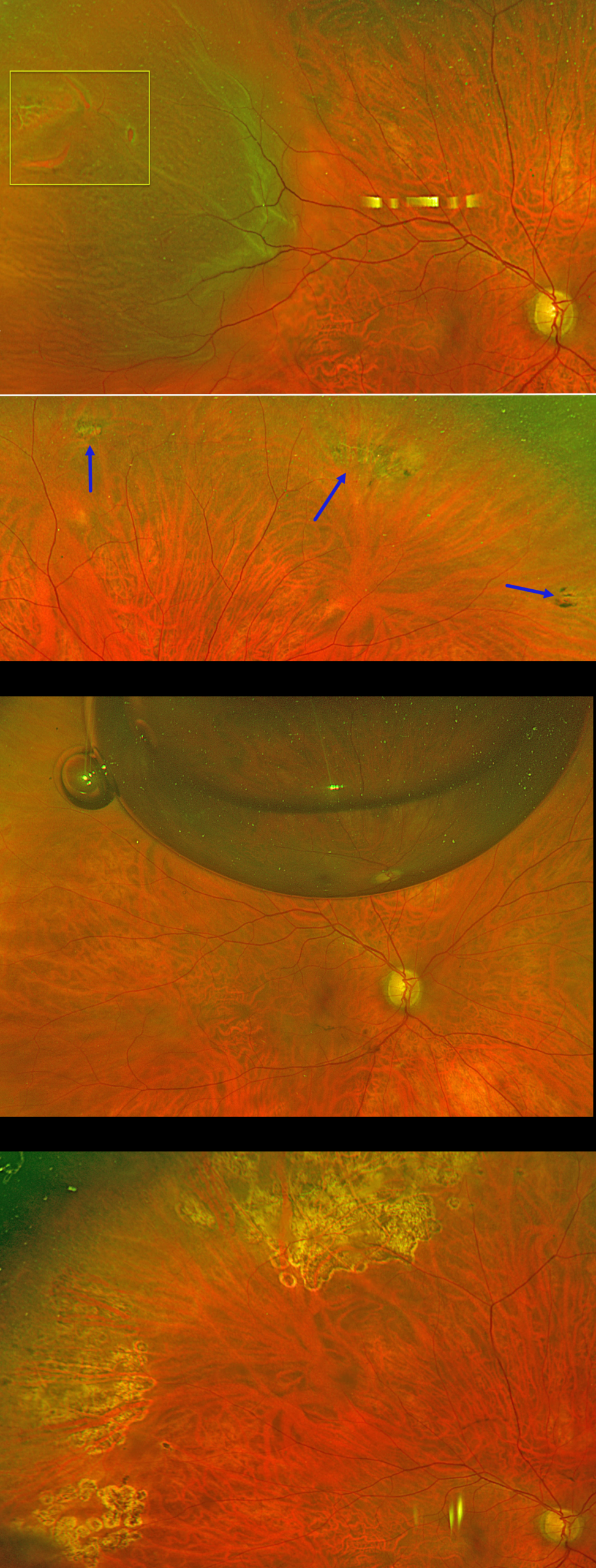
Optos color RG imaging shows a superotemporal macula-on rhegmatogenous retinal detachment (RRD) from several tiny adjacent breaks within lattice. There were other areas of lattice degeneration superiorly, inferiorly, and inferotemporally within the attached retina. Options for retinal detachment repair were discussed, including pneumatic retinopexy, scleral buckle, and vitrectomy.
The patient chose to undergo pneumatic retinopexy (PnRP) with 0.3cc of pure C3F8. The areas of lattice within the attached retina were lasered just prior to performing the procedure. The retina was completely attached the following day. The causative break was lasered four days later once the detachment flattened. Two months postoperatively, vision was 20/20, and the retina remains attached. Given the diffuse areas of lattice and absence of posterior vitreous detachment in the fellow eye, we performed prophylactic laser retinopexy to the left eye (not shown).
Learning Points:
PnRP was introduced by Hilton and Grizzard in 1986 as an in-office alternative to traditional retinal reattachment surgery (Ophthalmology 1986;93:626-651). It was initially recommended for detachments with one or more breaks within a single clock hour, located within the superior eight clock hours of the fundus.
Forty years after its introduction, the role of PnRP, compared with scleral buckling and vitrectomy, remains controversial. In Canada, where access to operating rooms is more limited than in the US, PnRP is often the initial treatment of choice for appropriate detachments. The Canadian PIVOT trial reported that PnRP offered better final vision, less vertical metamorphopsia, and reduced morbidity compared to vitrectomy (Ophthalmology 2019;126:531-539).
However, in the US, PnRP is not as popular except on a late Friday afternoon (we’re only partially kidding). A recent critical review (Chronopoulos et al, Surv Ophthalmology 2021;66:585-593) argued against PnRP for initial treatment due to the need for “multiple procedures that largely negate its potential cost savings and subjects the patient to prolonged stress and disability…” A recent cost-utility analysis surprisingly found PPV to be the most cost-effective primary procedure (Teja et al, AJO 2023;255:141-154).
Although extensive lattice degeneration is generally considered a contraindication for pneumatic retinopexy, we decided to perform prophylactic treatment. Our patient did well after lasering the areas of lattice prior to performing the pneumatic procedure and was followed closely with scleral depression exams.