
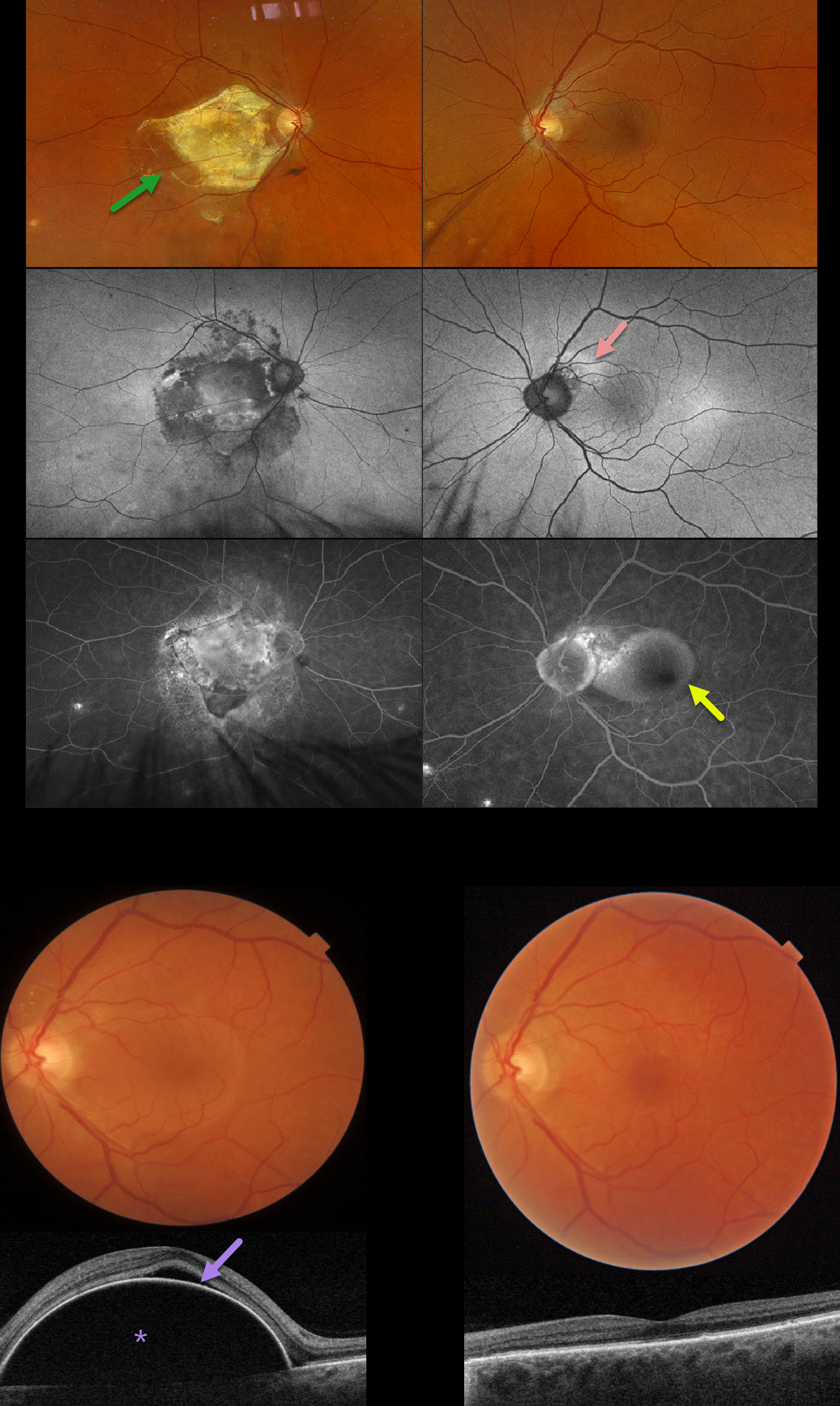
This 70YO male presented with 1 week of vision loss in his left eye. He has a long history of polypoidal choroidal vasculopathy (PCV). He received prior anti-VEGF injections OD, but his vision subsequently decreased to counting fingers from a fibrotic disciform scar due to poor compliance with office visits. Several years earlier, he developed a peripapillary polyp in his left eye that was resistant to Eylea monotherapy but responded well to combination treatment with photodynamic therapy (PDT).
Optos color RGB imaging shows a fibrotic disciform scar OD and a retinal pigment epithelial detachment (PED) OS. Fundus autofluorescence (FAF) shows variable hyper-FAF OS in the region of the prior polyp. Ill-defined angiographic leakage is noted superotemporal to the left nerve, with an uneven-filling PED. Triton swept-source OCT confirms a large and highly elevated PED with some overlying subretinal fluid.
Given the prior excellent response to combination treatment, intravitreal Eylea followed by PDT to the peripapillary notch was applied. Six weeks later, vision improved to 20/25, and the PED completely resolved with an almost normal OCT.
Learning Points:
Polypoidal choroidal vasculopathy (PCV) is a variant of type 1 macular neovascularization. PCV is likely distinct from age-related macular degeneration, occurring in a different population (more common in African Americans and Asians) and characterized by a thicker choroid and a relative lack of drusen. Historically, these lesions were believed to be somewhat resistant to anti-VEGF monotherapy, often requiring combined treatment with photodynamic therapy. More recent data from the PLANET study suggest that Eylea monotherapy is also effective (AJO 2019;204:80-89). However, our patient was resistant to monotherapy and responded remarkably well to combination therapy.
Originally described by Gass (Retina 1984;4:205-220), a notched PED is a sign of an occult MNV. The notch represents a type 1 MNV, which tethers the overlying RPE from the surrounding more highly elevated PED. Hydrostatic leakage from the MNV may contribute to the larger PED.