

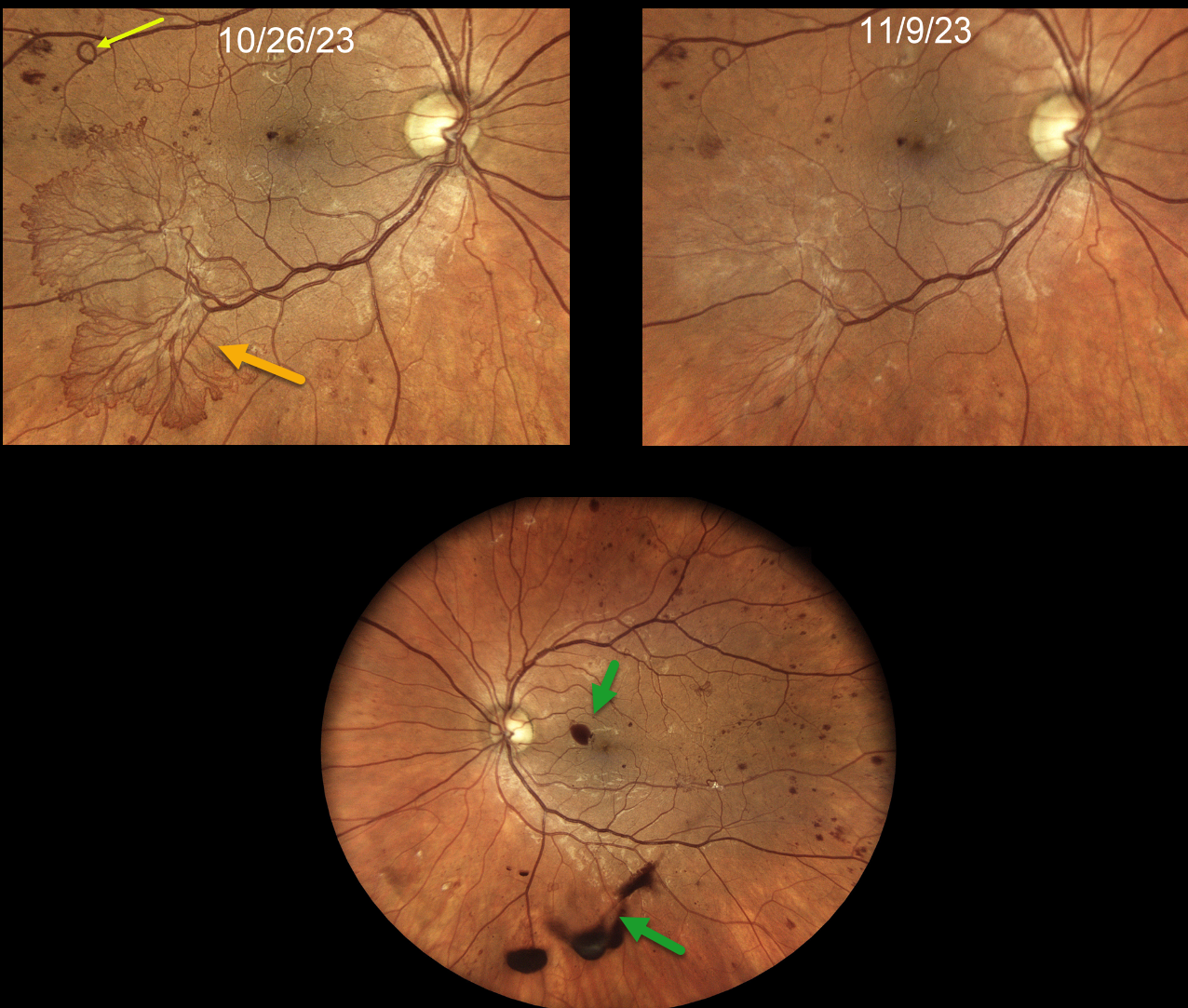
This 37YO female with type 1 diabetes presented with recent floaters in her left eye. It had been over 5 years since her last eye examination. Vision was 20/30 OD and 20/50 OS.
Colour photography shows a large flat area of active retinal neovascularisation in the inferotemporal macula of the right eye. Some foveal preretinal blood and scattered small retinal neovascularisation are seen in her left eye.
Panretinal photocoagulation (PRP) was recommended for her left eye. The decision for how to treat the right eye was more complex. After a long talk with the patient, we gave an intravitreal Avastin injection in her right eye.
She failed to show for her visit one week later, but thankfully came in 2 weeks following the injection. Vision was 20/30 OD, and the neovascularisation in the right macula had nearly completely regressed. PRP was started.
Learning Points:
Intravitreal anti-VEGF is commonly used before diabetic vitrectomies to cause rapid involution of the vascularized preretinal tissue and control intraoperative bleeding during membrane dissection. These injections are given within a week of surgery, as neovascularisation can contract, increasing traction. This uncommon yet well-known phenomenon is called the ‘crunch’ syndrome (Tan et al, Survey of Ophthalmology 2021;66:926-932).
We also sometimes like to use anti-VEGF injections to stabilize these more succulent retinal neovascularizations before proceeding with PRP. In our experience, anti-VEGF therapy causes a more rapid and complete involution than we see with PRP.
Of course, the flip side is an increased risk of ‘crunch’, so these patients need to understand the possibility of early vitrectomy and be followed quite closely afterward.