

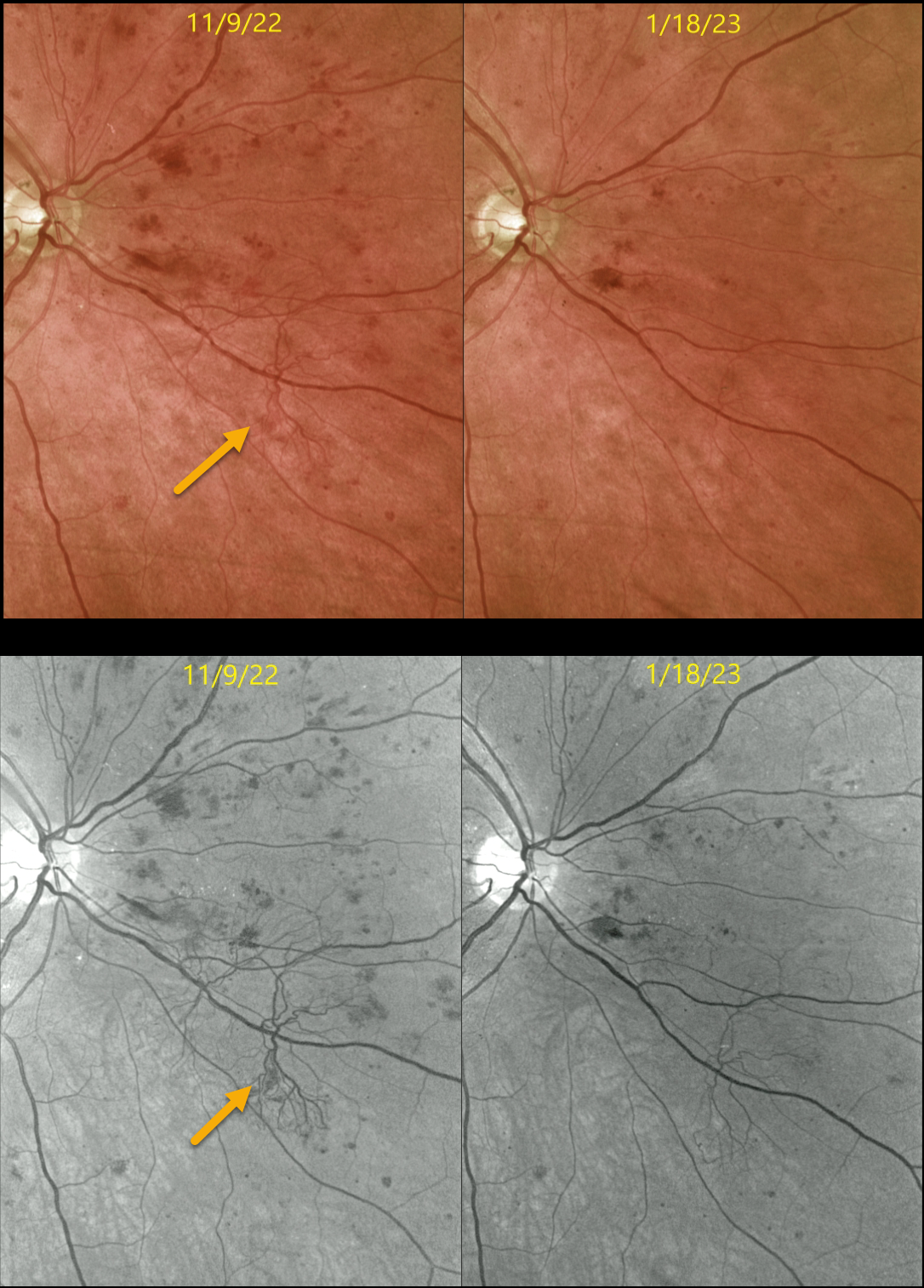
This 56YO male with type 2 diabetes presented on 11/9/22 with 20/30 vision OD with both central-involved diabetic macular edema (CI-DME) and proliferative diabetic retinopathy. Optos color and green-channel imaging show a large patch of retinal neovascularization.
Two monthly intravitreal injections of Avastin were administered for the CI-DME. On 1/18/23, vision improved to 20/25, and the edema completely resolved. The retinal neovascularization dramatically regressed. Macular laser for the injection treatment burden will be performed, followed by panretinal photocoagulation (PRP).
Learning Points:
The DRCR.net’s Protocol S explicitly compared PRP to Lucentis for the primary treatment of proliferative diabetic retinopathy (JAMA 2015;314(20):2137-2146). At 2 years, vision was equivalent between both treatment groups, and both treatments were equally effective in controlling neovascularization.
However, Lucentis-treated eyes experienced less peripheral visual field loss, developed macular edema less often, and needed fewer vitrectomies.
A secondary analysis of Protocol S suggested that Lucentis monotherapy was cost-effective for PDR+vision-impairing CI-DME but not for PDR without CI-DME (JAMA Ophthalmology 2019;137:1424-1432).
The role of intravitreal therapy vs PRP as the primary management for proliferative disease is intriguing, but in our practice, we find it difficult to justify, given the well-tolerated, long-lasting effects of laser therapy, contrasted with the risk of poor patient follow-up and the expense and treatment burden of anti-VEGF therapy.