

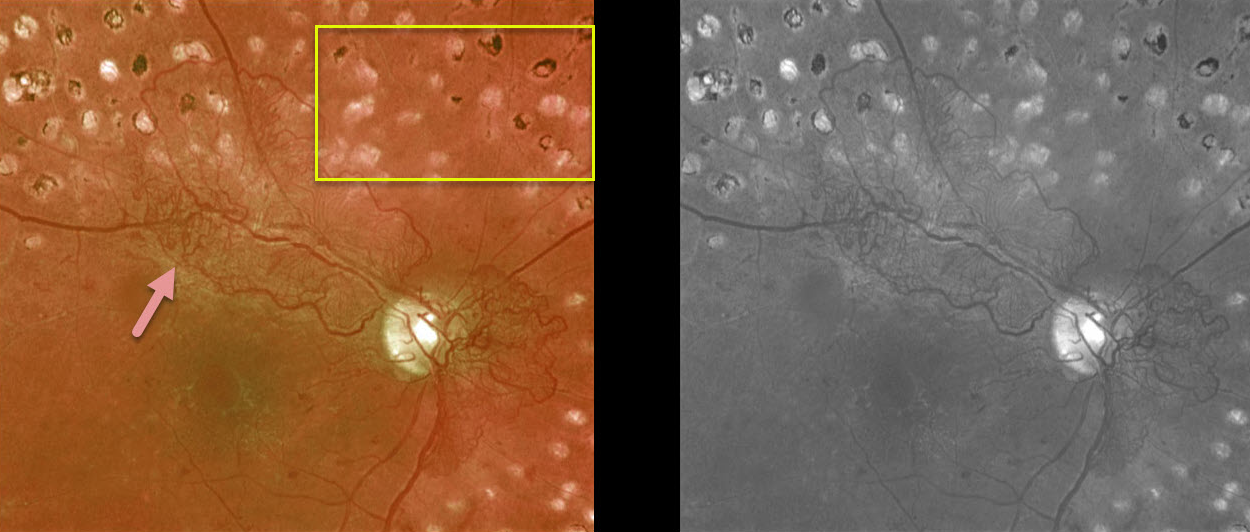
This is a 55YO diabetic patient who had been treated with complete panretinal photocoagulation (PRP). Vision was 20/40. Despite PRP, the patient still had significant residual posterior neovascularization.
Since it is not uncommon for neovascularization to persist following full laser, we are observing for now.
Learning Points:
Panretinal photocoagulation has been around since the 1960s and still remains the mainstay for treating proliferative disease. Often considered a “one and done,” patients can still develop breakthrough hemorrhages. Intravitreal anti-VEGF injections are often helpful, but some will require vitrectomy.