

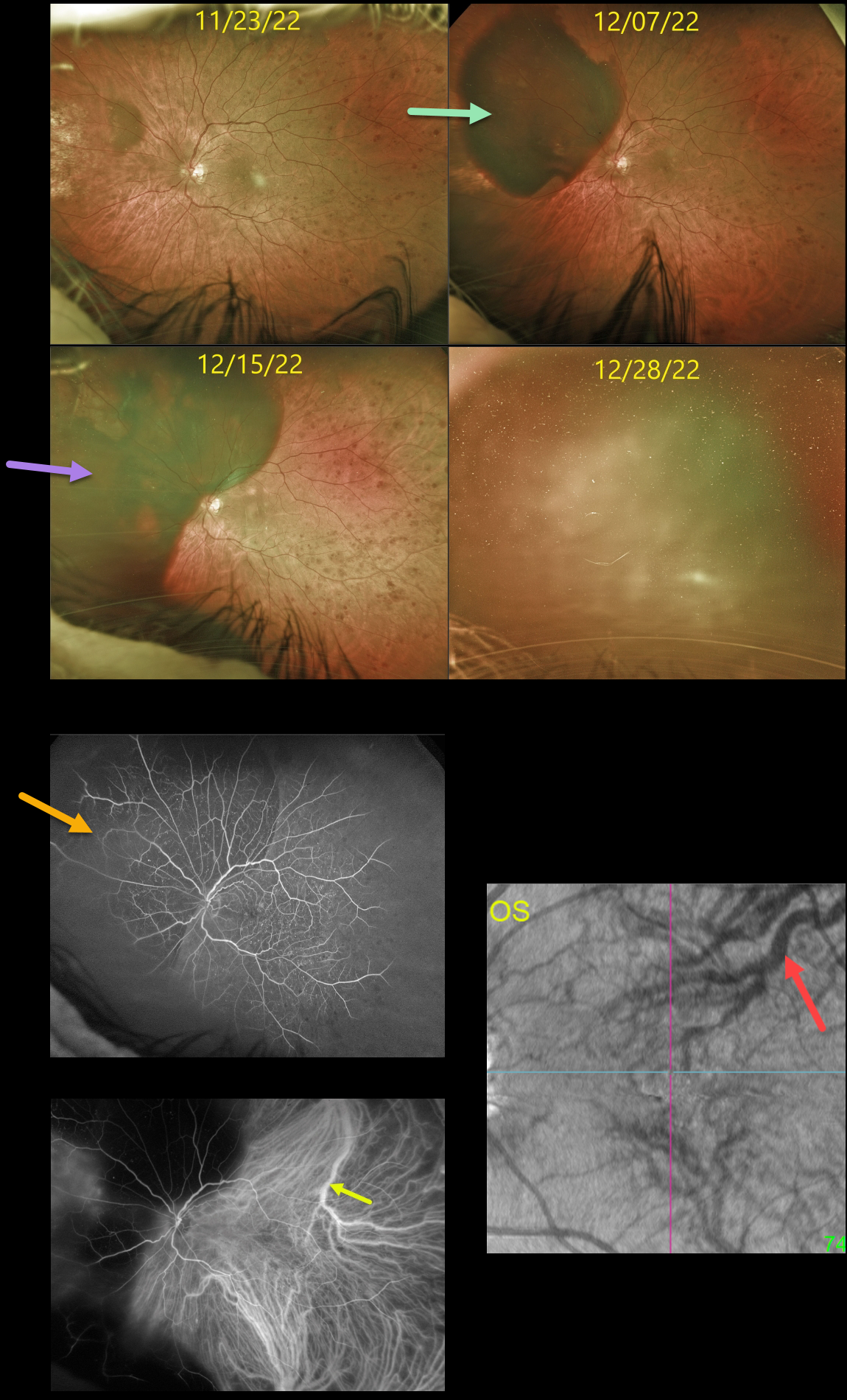
This diabetic male had been followed for over 5 years in our practice, receiving PRN intravitreal injections for diabetic macular edema.
On 8/10/22, he presented with a large superotemporal subretinal hemorrhage in his right eye that progressed into the macula (not shown). Vitrectomy with evacuation of the subretinal blood was performed.
Three months later, an inferior retinal detachment with proliferative vitreoretinopathy was noted (not shown). Staged cataract surgery followed by vitrectomy with silicone oil was performed.
At the 12/7/22 visit, the patient complained of new inferotemporal peripheral field loss, noting that “the same thing is happening in my left eye.”
Unfortunately, a superonasal subretinal hemorrhage was indeed found, and intravitreal Avastin injection was given the following day. However, one week later, the subretinal blood spread posteriorly.
Fluorescein angiography shows nonproliferative diabetic retinopathy with blockage superonasally from the subretinal blood. ICG angiography shows a large dilated superotemporal choroidal vein. En face OCT shows abnormal vortex systems, including a large, dilated superotemporal vortex vein.
On 12/28/22, the subretinal blood spread further with breakthrough bleeding into the vitreous.
Cataract surgery was performed, followed by vitrectomy; however, intraoperatively, once the vitreous hemorrhage was removed, he had a massive subretinal hemorrhage with an inoperable retinal detachment with proliferative vitreoretinopathy.
We believe our patient has an extremely unusual and aggressive variant of pachychoroid disease, as evidenced by the abnormal choroidal vasculature noted on ICG and en face OCT.
We have no explanation for why both eyes developed these massive subretinal hemorrhages, or why they developed almost concurrently. We plan on injecting his right eye with ongoing intravitreal Eylea in hopes of preventing recurrent subretinal hemorrhages.