
This healthy 31YO male presented with about 2 weeks of vision loss in his right eye. He also complained of mild headaches over the prior month. Vision was counting fingers OD and 20/20 OS.
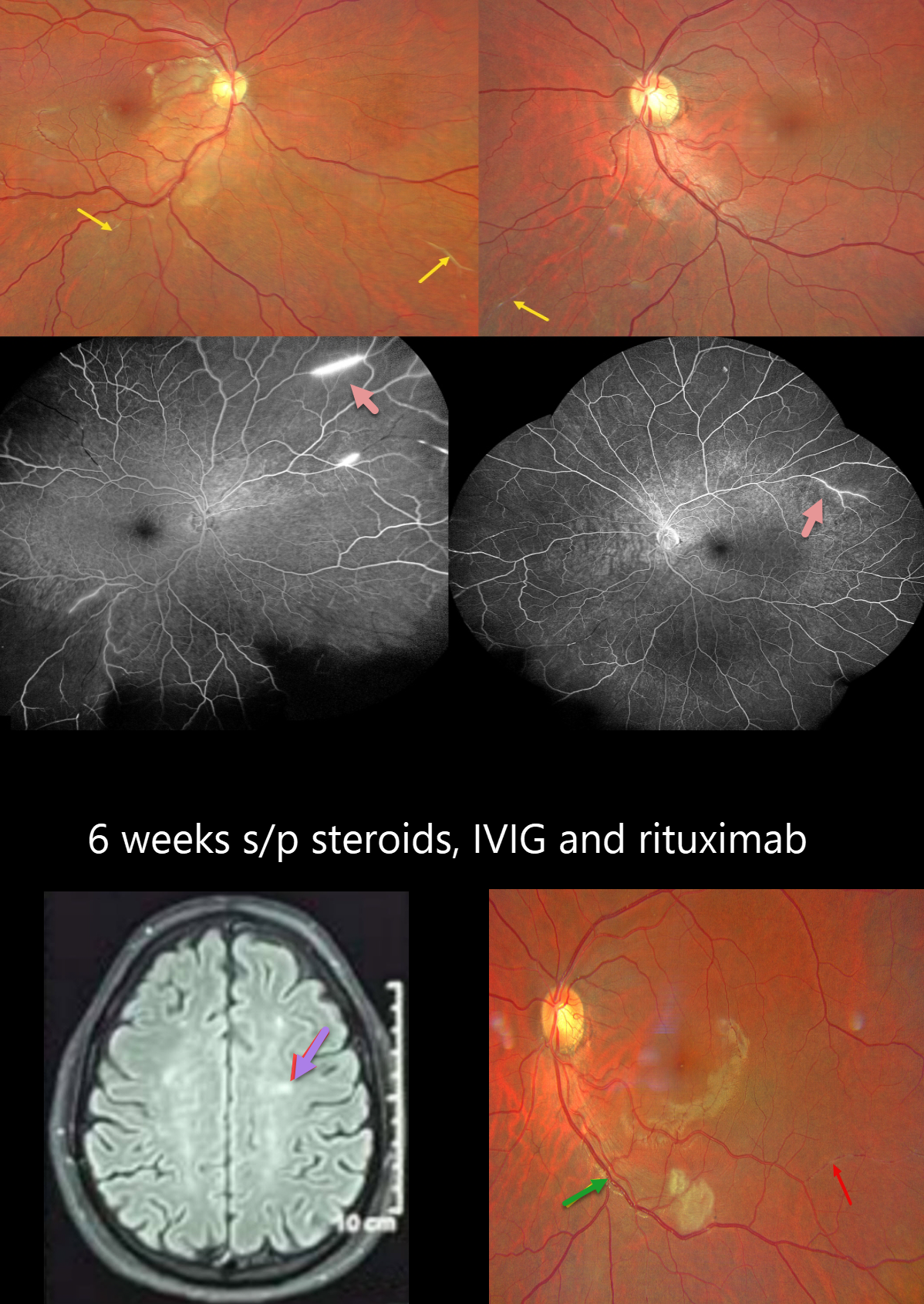
Fundus photography OD shows an opaque ischemic retina temporal to the disc, just sparing the fovea. Evidence of prior arterial occlusions is seen as bilaterally sclerosed vessels. Fluorescein angiography shows focal areas of scattered retinal ischemia with segmental areas of vascular staining.
MRI scanning shows multiple small, discrete, snowball-like lesions, and audiologic evaluation revealed bilateral mild sensorineural hearing loss, establishing the diagnosis of Susac syndrome. He was started on a 5-day course of intravenous immunoglobulins and steroids followed by maintenance rituximab therapy.
When he returned 6 weeks later, his vision was 20/80 OD and 20/20 OS. The nasal macular opacification is improving, but new areas of acute retinal ischemia are present in the inferior right and left maculae. Refractile deposits line an occluded arteriole along the left proximal inferotemporal arcade, and a new sclerosed arteriole is noted inferotemporally.
Learning Points:
Retinocochleocerebral vasculopathy, more commonly known as Susac syndrome, is a rare, microangiopathic disease of debated pathophysiology characterized by the classic triad of encephalopathy, sensorineural hearing loss, and branch retinal artery occlusions (Heng et al, Survey Ophthalmology 2019;64:477-485). The full triad may take months to evolve, frustrating the diagnosis. Retinal arterial wall atheromatous plaques, also known as Gass plaques, are often seen in later stages. They are a result of the occlusion, not the cause. The development of wide-field angiography has allowed for earlier detection and treatment. Although the findings are usually self-limiting while they wax and wane, systemic treatment with steroids and immunosuppression can be considered for more severe cases.