
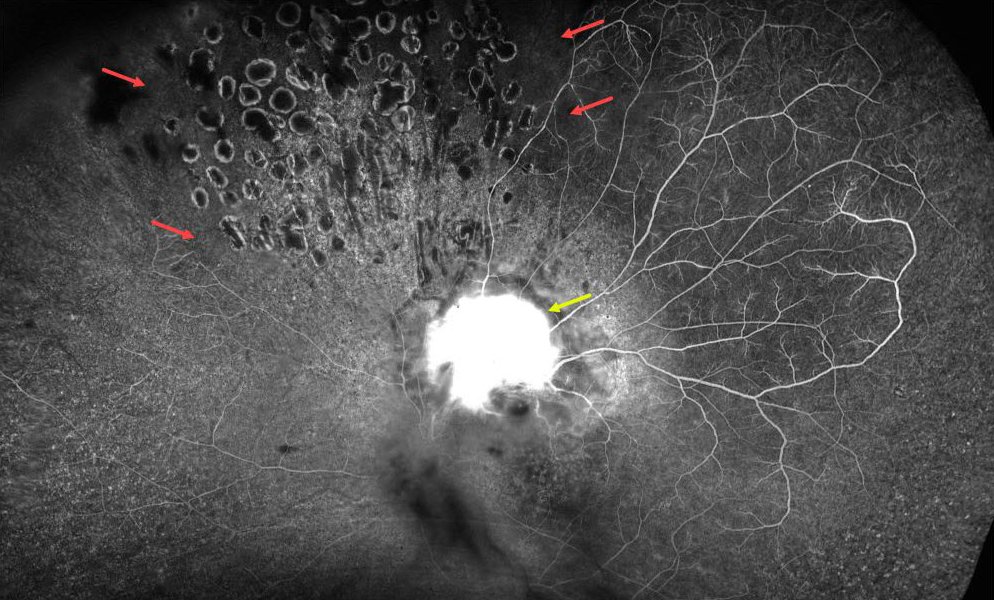
This patient had a uveal melanoma previously treated with plaque radiotherapy.
Although the tumor was destroyed, retinal capillary damage created ischemic regions and secondary retinal neovascularization. The tumor diffusely stains on fluorescein angiography. Although scatter laser successfully caused the neovascularization to regress, residual areas of nonperfusion remain.
Learning Points:
Retinal neovascularization, which develops at the vitreoretinal interface, is caused by retinal ischemia. Remember that neovascularization below the retina is usually caused by subretinal disorders.