
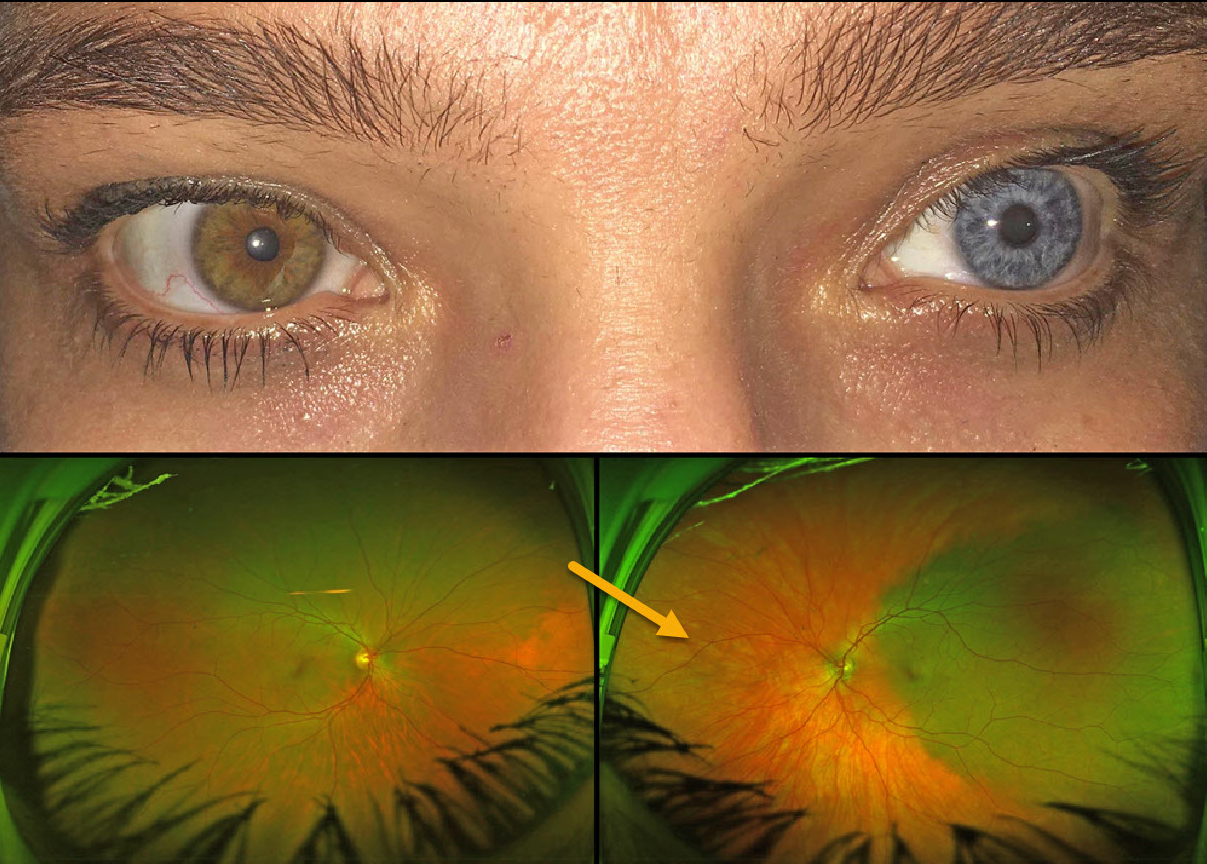
This 43YO female has a constellation of findings that are pathognomonic for Waardenburg syndrome type 1. Vision was 20/20 OU.
External examination shows telecanthus with iris heterochromia. When questioned, she mentioned synophrys (fusion of the eyebrows), which she removed with a laser, poliosis, which she dyed, and a family history of poliosis and heterochromia. She is also congenitally deaf.
Optos imaging shows apparent choroidal melanocytosis temporally in her left eye. But in actuality, this is the only normally pigmented choroid in each eye, with diffuse choroidal hypopigmentation elsewhere.
Learning Points:
Waardenburg syndrome is a group of usually autosomal dominant genetic disorders characterized by achromia of the hair and/or skin, congenital deafness, partial or total iris heterochromia, synophrys, broad and high nasal root, telecanthus, and choroidal hypopigmentation. Vision is usually normal, as was the case in our patient.
See Shields at al for a review of the iris and choroidal abnormalities found in Waardenburg syndrome (JAMA Ophthalmol 2013;131:1167-1173).