
Autosomal Dominant Vitreoretinochoroidopathy (ADVIRC)
<< Back to Cases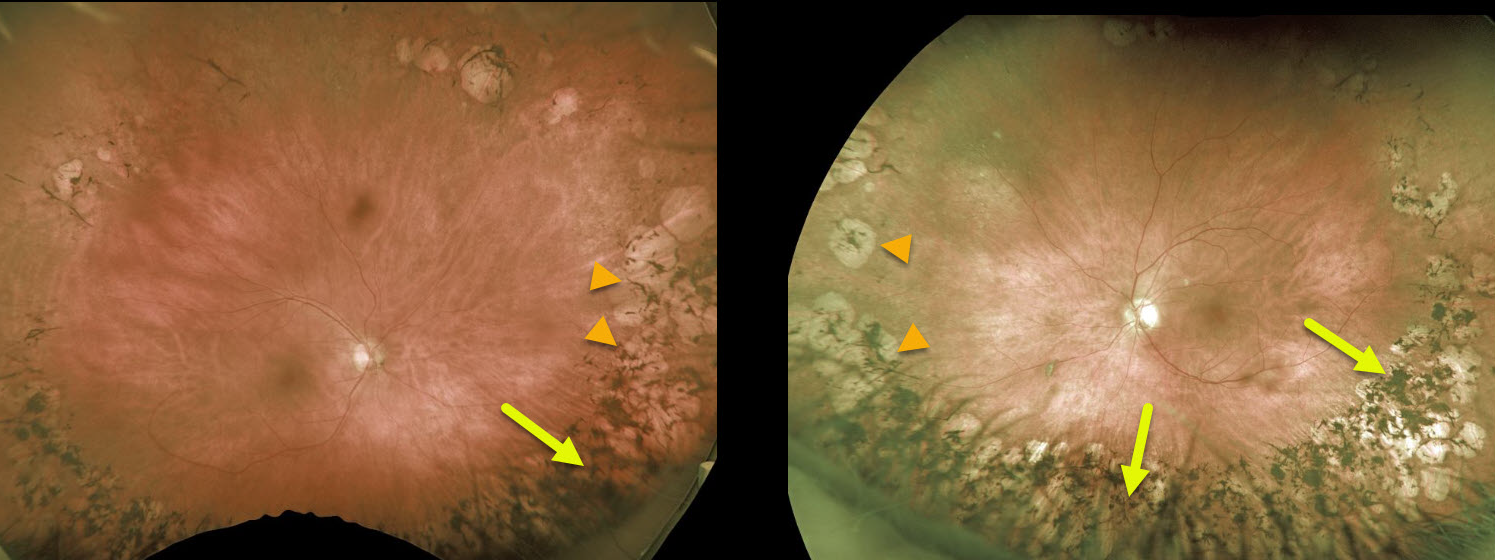
AUTOSOMAL DOMINANT VITREORETINO-CHOROIDOPATHY (ADVIRC)
Originally posted on @retina.rocks November 25, 2020
This patient has an extremely rare retinal dystrophy called autosomal dominant vitreoretinochoroidopathy (ADVIRC). Its most distinguishing feature is a band of circumscribed chorioretinal atrophy with intraretinal pigment migration extending circumferentially from the equator to the ora serrata.
Learning Points:
Autosomal dominant vitreoretinochoroidopathy was first described by Kaufman et al (Arch Ophthalmology 1982;100:272-278). It is caused by a mutation in the BEST1 gene, which encodes for bestrophin, a transmembrane protein in the basolateral plasma membrane of the RPE responsible for intracellular calcium homeostasis.
Aside from the pigmentary retinal changes, findings include punctate whitish pre-retinal opacities, vitreous cells and fibrillary condensation, and retinal neovascularization.
Anterior segment findings are common and include hyperopia and angle-closure glaucoma. There is wide phenotypic variability, and advanced cases can mimic retinitis pigmentosa (see Boulanger-Scemama et al Retina 2019;39:867-878).