

Ethambutol Toxicity
<< Back to Cases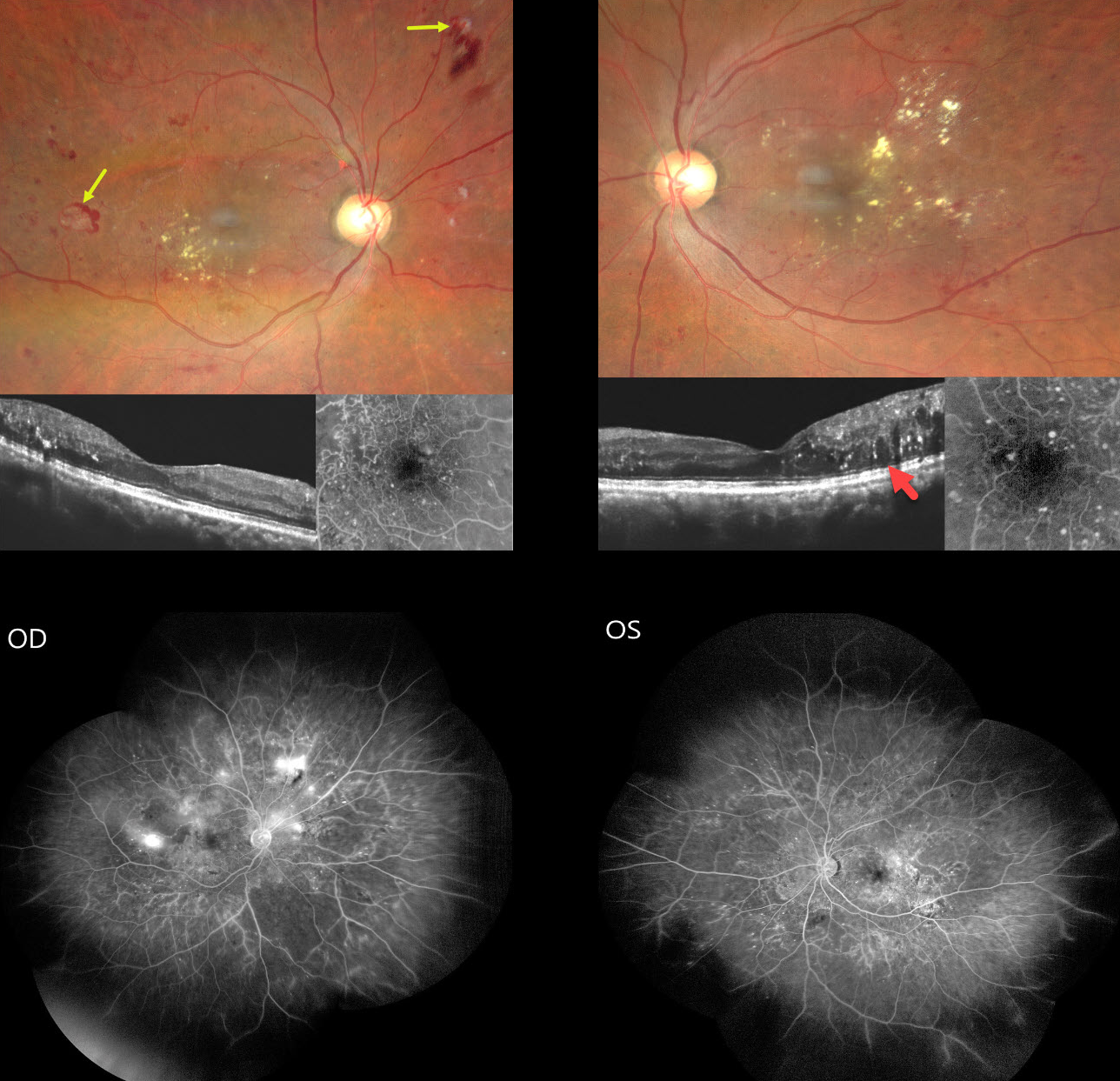
ETHAMBUTOL TOXICITY WITH CONCOMITANT DIABETIC RETINOPATHY
Ayushi Gupta and Vishal Agrawal
Originally posted on @retina.rocks May 4, 2026
This 54YO male presented for a second opinion with several weeks of progressive bilateral painless vision loss. He gave a history of active pulmonary tuberculosis, diagnosed about 6 months earlier, which was being treated with antitubercular therapy (ATT) including ethambutol. There was also a 5-year history of well-controlled type 2 diabetes. Vision was 20/200 OU.
Fundus photography shows bilateral non-central diabetic macular edema (DME) with mostly temporal lipid. The central macula looks fairly normal bilaterally on OCT, and fundus fluorescein angiography (FFA) shows relatively preserved foveal avascular zones. Retinal neovascularization (NV) with some associated preretinal blood is noted OD. Widefield FFA confirms scattered retinal NV OD with moderate bilateral capillary nonperfusion. Disc OCT showed a normal retinal nerve fiber layer, and 30-2 visual fields showed severe generalized depression (not shown).
Learning Points:
Our patient was previously seen by other specialists who felt that diabetic retinopathy was the sole reason for his complaints and findings, despite the lack of central foveal fluid or ischemia. Our patient reminds us of 2 dictums in medicine: 1) we try to explain all findings by a single disease, and 2) that a patient can have as many diseases as they so desire. In our patient’s case, we felt that ethambutol better explained his clinical picture.
Ethambutol is one of the agents used as part of ATT, a multi-drug regimen for treating active tuberculosis. About 1-3% of patients can develop drug-induced optic neuropathy, most commonly following 2 months of therapy but rarely developing within days of starting treatment. Symptoms include decreased visual acuity, scotoma, color blindness, and visual defects in one or both eyes.
Although the FDA recommends baseline visual acuity and color vision testing, followed by monthly color discrimination testing during therapy, there are no studies demonstrating any benefit of such screening. Ethambutol should be discontinued if toxicity is suspected. Although vision loss is often thought to be permanent, a recent systematic review showed significant improvement in vision, color vision, and visual field loss with discontinuation of the drug (Sabhapandit et al., Indian J Ophthalmol 2023;71:729-735).
We contacted our patient’s pulmonologist, who stoppe therapy immediately. Anti-VEGF therapy followed by panretinal photocoagulation was recommended.