
Helicoid Peripapillary Chorioretinal Degeneration
<< Back to Cases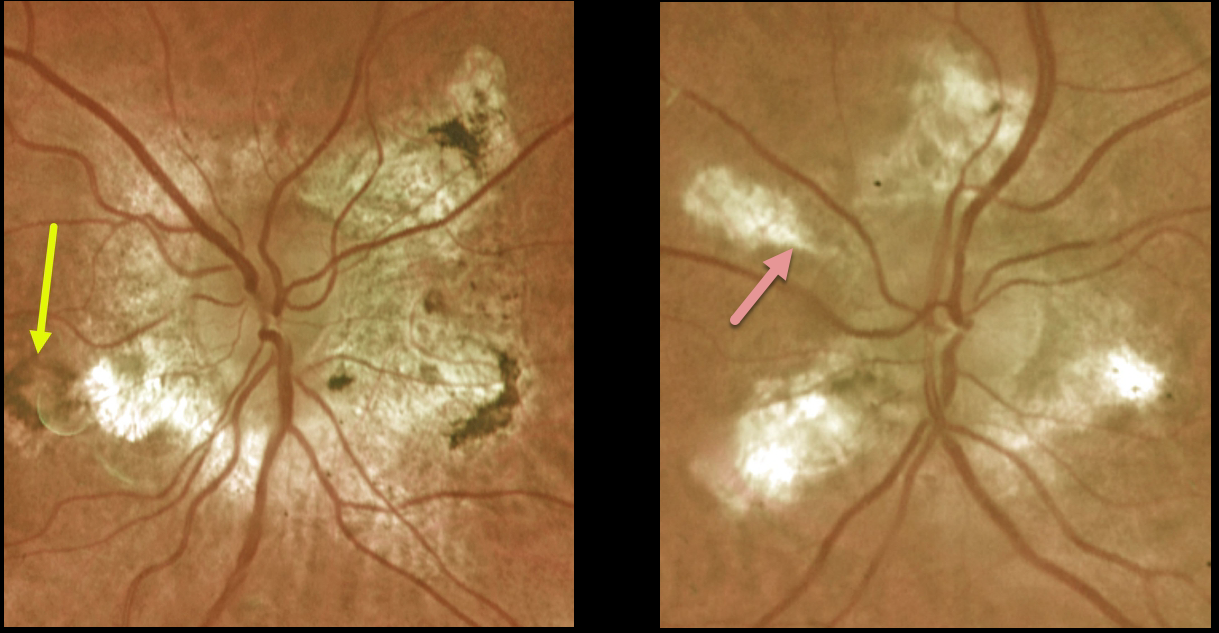
HELICOID PERIPAPILLARY CHORIORETINAL DEGENERATION
Originally posted on @retina.rocks September 30, 2022
This 65YO female is receiving ongoing anti-VEGF therapy in her right eye for macular neovascularization (MNV).
Optos imaging shows an inactive pigmented MNV OD and bilateral peripapillary degenerative propeller-shaped lesions radiating from the optic nerves.
Vision is 20/40 OD and 20/30 OS.
Learning Points:
Helicoid peripapillary chorioretinal degeneration (HPCD) is a benign autosomal dominant disorder caused by a mutation in the TEAD1 gene.
It is characterized by a unique pattern of bilateral peripapillary chorioretinal atrophy. These degenerative wing or propeller-shaped lesions radiate centrifugally from the optic nerve head.
Vision is usually normal, although central vision can rarely be affected if atrophy progresses through the fovea. MNV can rarely develop as in our patient (see Triantafylla et al, Eur J Ophthalmol 2016;26:e30-e31).
HELICOID PERIPAPILLARY CHORIORETINAL DEGENERATION
Originally posted on @retina.rocks January 19, 2021
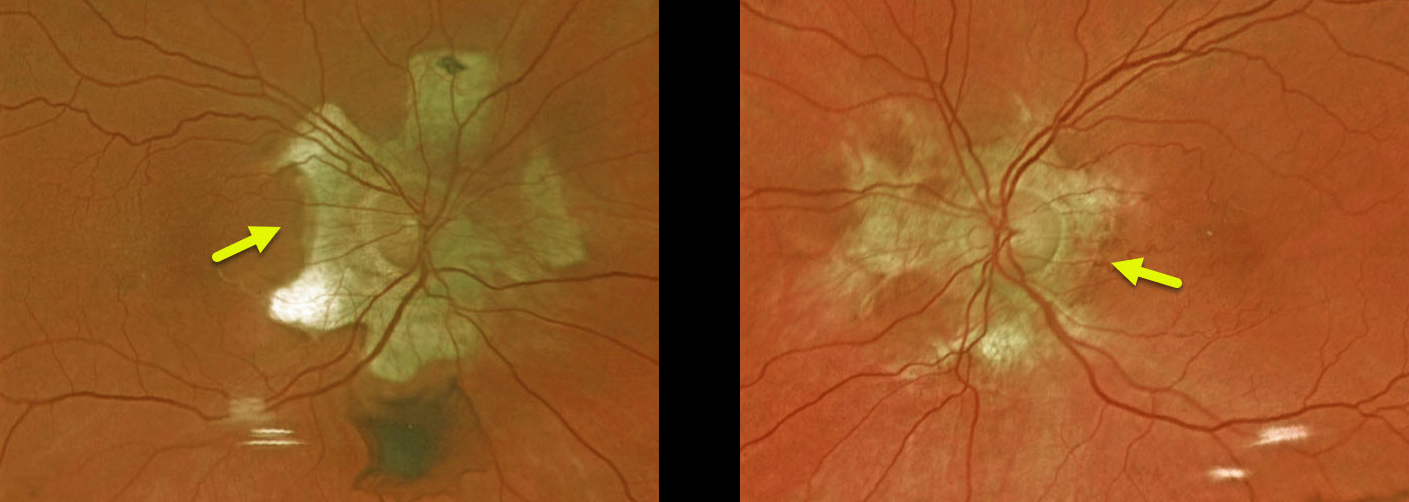
This asymptomatic patient was found to have a unique bilateral peripapillary chorioretinal atrophy called helicoid peripapillary chorioretinal degeneration.
Vision is usually normal, although central vision can rarely be affected if atrophy progresses through the fovea.
Learning Points:
Helicoid peripapillary chorioretinal degeneration is a benign autosomal dominant condition with degenerative wing or propeller-shaped lesions that radiate centrifugally from the optic nerve head.
HELICOID PERIPAPILLARY CHORIORETINAL DEGENERATION
Originally posted on @retina.rocks March 27, 2020
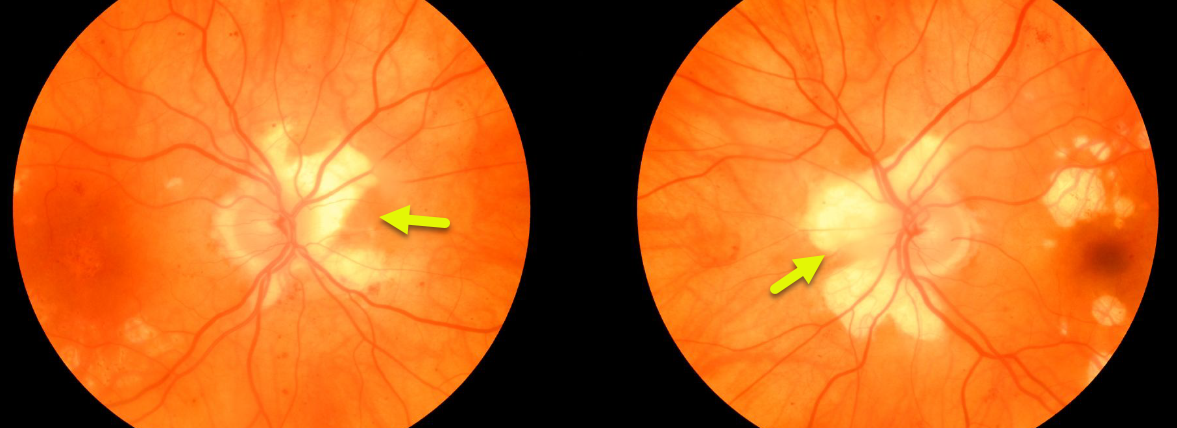
This asymptomatic patient was found to have a unique bilateral peripapillary chorioretinal atrophy called helicoid peripapillary chorioretinal degeneration.
Vision is usually normal although central vision can rarely be affected if atrophy progresses through the fovea.
Learning Points:
Helicoid peripapillary chorioretinal degeneration is a benign autosomal dominant condition with degenerative wing or propeller-shaped lesions that radiate centrifugally from the optic nerve head.